Wednesday, 19 April 2023

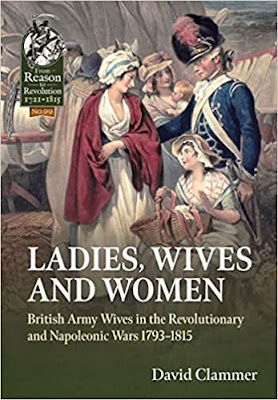
Reading on the Great Procession - Ladies, Wives and Women review.

 
Often mentioned in passing without further explanation the question of what the wives of soldiers went through in order to remain with their men. Your typical soldier from any nation in the Revolutionary and Napoleonic Wars had a pretty tough life; the officers’ ladies, soldiers’ wives and other women had an even tougher time.

‘Ladies, Wives and Women. British Army Wives in the Revolutionary and Napoleonic Wars 1793-1815’ by David Clammer is No. 99 in Helion’s excellent from Reason to Revolution series. The author investigates in detail what has been until now a rarely explored and perhaps also understood topic.

For me, as a lover of first hand accounts, this book paints a vivid picture of every aspect of service life these women were faced with; fear, hunger, exhaustion, extremes of weather, distress at being left behind when the regiments sailed overseas, and of course injury, abuse and death in many forms were the norms, but these were offset by the stamina, resilience, humour, determination, attributes also seen in their menfolk. The book is full of contemporary correspondence and diary entries which give the experiences of these remarkable women the appropriate context. Many of those being described are quite harrowing.

The book includes a number of contemporary illustrations as well as a couple of useful maps. Briefly the book looks at every aspect of life each in discrete chapters, for example, from the army’s view on marriage and the regulations, joining the regiment, choosing lots for accompanying their men overseas, the truly awful life aboard the troopships, the hazards and rigours of campaign and in battle. There is a particularly good chapter dedicated solely to Corunna. The final chapter looks at how these women and their menfolk assimilated back into peacetime soldiering or civilian life.

In summary, this book draws you in, and makes sure that the lives of British army wives will no longer be overlooked. It is well written and clearly very well researched. Part militant study, part social history, it is an important book for that reason alone and it should be a must for every enthusiast for the period.

ISBN 978-1-915113-90-0 , 256 pages.


Tuesday, 11 April 2023

Reading on the Great Procession #6 - ‘SCIENCE OF ARMS Vol.1’

I hope nobody is getting bored with these book reviews but there’s precious little about wargaming I can discuss while embedded in Indian (Parsi) culture. It is wonderful though…….Next time I will bring some figures to paint.

Anyway, after I’ve read this new book in Helion’s Century of the Soldier series I feel very well equipped, were it something on my bucket list of things to do, to raise a regiment of foot and march off to glory in the service of my King, or whomsoever holds the purse strings. ‘Science of Arms: The Art of War in the Century of the Soldier 1672-1699, Volume 1: Preparation for War and the Infantry’ by Stephen M. Carter is in effect the perfect toolkit (one could say the complete military manual) for anyone wishing to dig down and understand what lay behind the actions of the period’s greatest (and not so great) generals, and their men, as they prepared for and waged war.

Conceived as part one of a three-part series to say that the author has set himself an ambitious task is something of an understatement.

Volume 1 is divided into three sections; looking at ‘War Policy’ (understanding and preparing for war), ‘Modelling the Army’, which covers everything from the Captain General down to the most junior soldier. This section includes the rather detailed responsibilities of the great and the good, be they the Master of Orndnance or the Adjutant-general to name but two. Suffice to say that the detail presented in this section is superb, in particular the narrative covering the formation and structure of infantry, cavalry and artillery the army. For those that like them, there are loads of fascinating charts and tables covering clothing and equipment issues. The final section focuses on the infantry, examining the roles of the regimental and company officers and on the tremendous amount of drill and skill at arms imposed on the men in order to make them function as soldiers.

The book is largely a compilation of British and European military manuals and texts, brought together to give the reader a complete treatise on the workings of the infantry as an arm both on and off the battlefield. Subsequent volumes will examine the same for cavalry and artillery, and the importance and science of siege warfare in the golden age of Vauban.

Unsurprisingly the book is full of a huge number of wonderful contemporary images depicting soldiers at drill, and the formations and actions they were expected to function in. It must have been a labour of love to research and write this book. I’ve never come across so much information presented clearly in such a limited space of just 300 or so pages.

I can wholeheartedly recommend this book. For someone with an interest in the armies of the late seventeenth centuries this book is simply a gold mine of information, and I look forward with great anticipation to the arrival of the next in the series.


ISBN 978-1-804510-02-5. 330 pages.


Sunday, 9 April 2023

Yet more reading on the Grand Procession #5 Hungary 1849

Spent Easter weekend chilling, doing lunches and coffees with the extended family, so plenty of time to write up another review. 

I was well impressed with the first volume of this series that focussed on the winter campaign of 1848-49, so had high hopes for ‘Hungary1849, ‘the Summer Campaign’. I am not disappointed. The official Austrian history of the war takes us towards the fierce battles of 1849 and the subsequent failure of the uprising. Chris Pringle has again done a superb job in editing the translation of the original German text leaving us with a level of detail unsurpassed in anything previously published in English on what was one of the largest insurrections of 1848 that swept through Europe at that time.

The book is big in detail and in physical size, at 554 pages. It covers the decisive second half of the war, where the Kaiser, defeated in 1848, called for assistance from the Russian Czar. Assailed from all sides, fighting some brilliant delaying actions and even winning some victories, we are treated to a piece by piece account of the destruction of the insurrection. It seems that every action, great or small, between the Hungarian forces and those of the Kaiser and the Czar is covered, often in great detail. I won’t begin to list the various chapter headings and sub-headings; take it from me this is a most comprehensive and fascinating step by step account of the war across all theatres of operations.
There are sections on the armies involved, and there are numerous detailed orders of battle throughout the book, together with several maps which will be of great interest to the casual reader as much as the historian or wargamer. There is much to recommend this book; a sympathetic translation, forensically researched and presented, and a cracking read to boot! If the nineteenth century and the years of revolution are your thing then this is the book for you.

Only two weeks until we return to the UK. Not in any rush to go home but my little men are beckoning me…..

ISBN 978-1-915113-80-1 554 pages

More Reading on the Grand Procession #4

Actually, we’ve stopped ‘Processing’ for the time being and spent a very pleasant week in Bangalore meeting up with our large extended family, and Katherine’s friends and former colleagues from when she lived here. Lots of time for reading too.

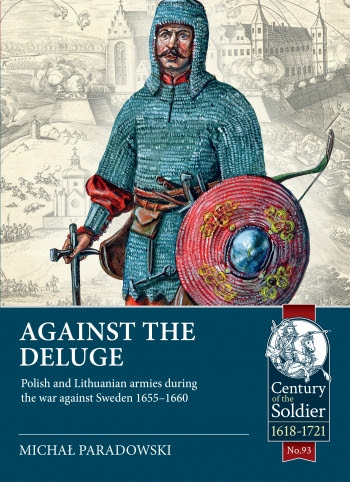
Michal Paradowski has surely produced his best work to date in ‘Against the Deluge, Polish and Lithuanian armies during the war against Sweden 1655-1660’.

The book focuses primarily on the war against arch enemy Sweden, and how the Polish and Lithuanian armies were recruited, organised, equipped and fought. The book also covers the Cossack Revolt. What is fascinating is the way the Poles dragged themselves from almost complete defeat to victory, and how the war spread to include a significant number of European powers who threw in their lots with one side or the other (or in the case of Brandenburg, one then the other!).

As ever the narrative is filled with contemporary correspondence, largely diaries and letters many previously unseen, one of which sticks in my mind where a soldier recounts quite matter of factly how he and his comrades tried rather gruesomely to put a grievously wounded enemy out of his misery as an act of kindness! 

What I will say about this book is that it is an absolute cracker. Extensively researched using many new primary sources the book is filled with detail, contemporary accounts and illustrations, loads of useful maps (so often not the case in other publishers’ works), and a bumper selection of eighteen pages of specially commissioned colour paintings by Sergey Shamenkov, of uniforms and banners of the Polish forces. Every aspect of the conflict is explained in great detail, including chapters on the commanders, weapons, organisation and recruitment, and battles and skirmishes. There is more, including nine excellent appendices covering everything from lists of prisoners to orders of battle. 

It goes without saying that this book is an excellent and well presented account of a critical period in Poland’s history where she was fighting for her very existence assailed by enemy on all sides. It is a testament to the courage and determination of the Polish and Lithuanian armies that they prevailed, and Michal does a grand job in bringing this all to life. 

If you already have the author’s other books you will not want to miss this one. If you don’t have them you really should if this period of history interests you as much as it does me. A worthy addition to anyone’s library and well done Helion yet again for another super book!

Sunday, 2 April 2023

Keeping the Royal Mail going

 My daughter very kindly took the following pictures of some parcels that have arrived for me while we’ve been away for the past seven weeks. I mean, how could they all be for me as I wasn’t even home to order them? What? The internet? Guilty as charged so I can only throw myself on the mercy of the court (wife). I can’t even remember what most of them might contain so it’ll be just like Christmas!


Another three weeks or so before we’re home so I must try and contain myself! I mean I was supposed to be downsizing when I got back!!!!!


Saturday, 1 April 2023

Serangapatem Fortress

Thursday saw us head south to Serengapatem and Mysore. Just over two hours by car on a very good road/motorway. Much warmer in Mysore than Bangalore but not unbearably so - mid to high 30sC so very pleasant if somewhat airless and humid. The fortress was stormed in 1799 by the British and their allies from Hyderabad after a siege lasting from 4 April to 5 May, which is one of the hottest times of the year. Tipu was killed and that marked the end of the Fourth Anglo-Mysore War. The fortress was pretty much demolished during the siege and the central area now houses a small town along with local police married quarters. Enough is still standing to get an excellent idea of what it must have looked like. 


Dungeons where Tipu kept his captive English officers.


A depiction of the death of Tipu Sultan during the storming of Serengapatem.
The Water Gate where Tipu was killed. ( see photo above)


We also visited Tipu’s palace across the road from the fortress, which will be the subject of another post, as will the visit to the Madras Palace in all its pure Victoriana finery. I have a few good ideas for terrain items, such as paddy fields and sugar cane fields. How I’ll do the latter I just don’t know yet. 

Wednesday, 29 March 2023

Tipu Sultan’s Summer Palace, Bengaluru

Bangalore enjoys quite a temperate climate compared with much of the rest of India, and for this reason was chosen as the site for Tipu Sultan to build his summer palace in the 1780s.

Today it is not exactly in the best condition but it is slowly being preserved and repaired. I thought it’d be bigger but I guess it WAS bigger before the British ousted Tipu and win control of Mysore. The columns and walls and ceilings are all solid teak.

Rockets for Tipu!


Hindu temples like this one were built on the sites of earlier Moslem palaces.


                        The interior of the palace. 


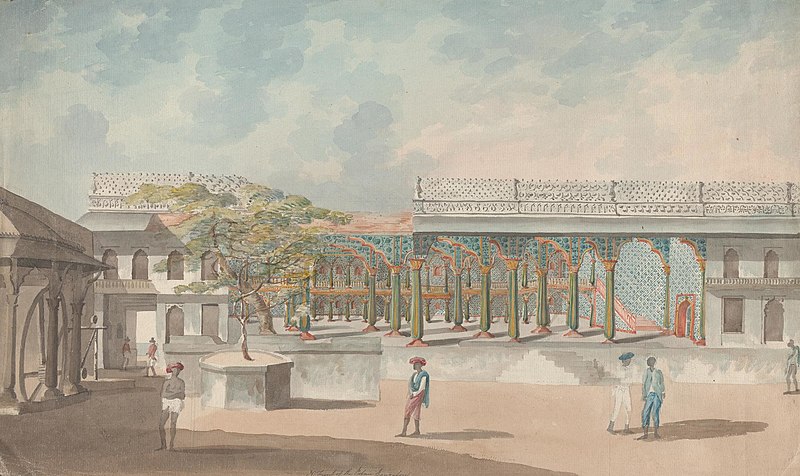
Below are images of some contemporary paintings of the palace by an English officer, James Hunter. https://en.m.wikipedia.org/wiki/James_Hunter_(military_artist) He was a lieutenant in the Royal Artillery and served under Cornwallis at Serengapatem. He died in 1792 and is buried in Vellore.


The palace in the mid-nineteenth century.

On Thursday we are off to Serengapatem and Mysore for a couple days. Looking forward to it. My Wellington In India itch is being well and truly scratched!