Sunday, 10 September 2023

Back to India………well for a Sikh Wars game anyway!

It was about time these chaps came out of the box again, so yesterday’s game was a Sikh Wars encounter. It was to be a simple affair as I wanted to see if General d’Armee could be adapted for this conflict. The weaponry was much but not exactly the same as in the Napoleonic Wars, but it was going to be interesting (I hoped) to see if I could successfully replicate the very different troop types and qualities of the soldiers themselves. I will sum these up at the end of this post.

Nigel and John the Red played the British while Richard and I commanded the Sikhs. The scenario was pretty simple. The Sikhs had managed to get their army astride the British lines of communication so General Gough led half his Army of the Sutlej to clear them off, while a (mythical as it turns out) flanking force was set to hit the Sikhs on their right flank. This was simply to get the Sikhs to act a little more passively than they might otherwise have done (I didn’t tell Richard Singh it was a ruse, and he was expecting more Sikhs to arrive).

In time honoured manner there follows some photos of the game, which in time honoured manner Blogger has managed to randomly reorder out of sequence.

The battlefield from the ‘garden end’. With the exception of the nullah in the distance and the village with its poppy field the terrain was relatively open, dotted with some low lying jungly bits and rough ground, which had no effect on the game.

The British right flank, two brigades of cavalry and supporting Bengal Horse Artillery.

Facing them the Sikh left looked menacing and colourful. But would the Gorchara feudal cavalry and zamburek camel gunners be able to hold their own? 

Guns! Guns! Guns! The Sikhs were very well supplied with artillery, too well said the British, but they would say that. Above are three large batteries of medium field guns.

More Guns. This time three heavy batteries in position behind the nullah.

Our right flank was held by four battalions of feudal Sikh infantry. 

Facing them across the nullah was a brigade of Indian cavalry.

Time for an early drink. A broken down commissariat wagon ‘guarded’ by British infantry. One of them has already passed out with liberated arak and another inebriated comrade is falling off the wagon.

Turn 1 and my cavalry were hesitant and didn’t move.

The zambureks were also hesitant and rooted to the spot.


Nigel launched his Bengal Light Cavalry at my stationary horsemen and camel guns, with predictable results.

This regiment of Bengal Irregular Cavalry smashed into the hesitant zambureks and broke them.

My favourite uniforms, the Bengal Horse Artillery in action.

The Governor General’s Bodyguard.

Sikh artillery holding the centre. They kept becoming hesitant so couldn’t fire at long range, which kind of made them impotent?

Richard was having similar issues with controlling his troops but one brigade advanced up the nullah.

I pushed my Akalis forward to slow down the advancing British, but the fire from the 60th Rifles and then follies from the infantry in line behind them saw them off.

HM 3rd Light Dragoons. 

While all this was going on around them the villages enjoyed another day watching snake charmers, rope trick climbers and other delights.

BHA galloping off somewhere.

Bengal Foot Artillery manning a battery of heavy guns.

The British right flank was making great headway against the crumbling Gorchara cavalry under my command.


Bengal Foot Artillery trading shots with the Sikh guns.

Sikh feudal irregulars holding the line of the Nullah.

John managed to get a brigade of cavalry over the nullah after the defending Sikh feudal infantry were driven off.

British advancing on their left. They had suffered terribly from the Sikh heavy guns but were able to sidestep out of trouble and continue their advance.

Nigel’s cavalry had driven off all my cavalry then hit the flank of the retreating Akali, all of whom were ridden down. They were then poised to roll up the Sikh artillery.

General advance on the British right.

With the Sikh left driven off and the right starting to crumble we called it a day, and announced a victory for the British. Their plan to defeat our left flank worked a treat, and I was not helped by my troops becoming hesitant far too often. Our artillery certainly pounded John’s advancing infantry, causing significant losses, but it wasn’t enough.

The rules worked ok. It has been a while since we last used them and we were VERY rusty, but they certainly have the potential for the Sikh Wars, and no doubt the Crimea as well.

In terms of troop classifications, the Queen’s troops and European units in the HEIC army were all graded as veteran, while the Sepoys, with the exception of the Gurkhas, were bog standard line. The BHA were elite.

The Sikh artillerymen were graded as elite. The infantry were everything from elite, to line and militia. The Gorchara were classed the same as Cossacks in the rules. Probably a bit mean to do that but….?

One change I did make was that the Sikhs had to score a 4+ to gain an ADC (rather than 3+) and their brigades had to also score 4+ to activate (again, instead of 3+). This idea worked very well and seriously hampered our plans, ensuring a fairly static game for the bulk of the Sikh infantry. What ADCs we got were usually expended on the artillery, but with the amended activation score, they became hesitant quite often. I need to rethink a few things, such as trying to reflect the Sikh artillery more effectively, and maybe restrict all or most Sikh musketry to the inferior line. 

Anyway, everyone said they enjoyed what was a most colourful game. The pizzas for lunch were annihilated in very short order too.

Friday, 8 September 2023

A Wargamer’s Guide to War of the First Coalition, 1792-1797

This arrived with a massive thump as it hit the doormat on Friday, and what a whopper it is; ‘A Wargamer’s Guide to the War of The First Coalition, 1792-1797’, by Garry Mills. This period is, as I am sure folks know, a subject very close to my heart and I was all a-flutter when I read through it last week.

What does the reader get for his money? In a words, LOTS! After the introduction there is a brief history of the French Revolution followed by a very comprehensive year-by-year and by theatre of war, outline of the war which takes up a third of the entire book. There is a useful chapter covering each nation involved in the war, big players and small, including France, Great Britain, Piedmont, Austria, Prussia, Spain, the United Provinces, Naples and Emigre and other Royalist forces. These sections include a description of each nation’s armed forces, organisational details and more. 
There is even a piece on naval forces employed in the war.

Given that this is a wargaming guide, it is no surprise that  the following chapters cover ‘Wargaming the Period’ and ‘Building the Forces’.  These are thoughtfully presented and will be a big help to anyone new to the period. Also in this section is a how to painting guide.

The next chapter includes 10 ready-made scenarios, including three dedicated to naval battles. The land-based scenarios are full of detail, representing a variety of protagonists and size of engagement, and come with maps, orders of battle, troop qualities and so forth, starting with Lincelles and ending with Castiglione.

The book concludes with sections signposting readers to suppliers of miniatures and terrain and online resources available, together with an extensive bibliography.

As well as the maps there are a number of contemporary illustrations both in colour and black and white, and photographs of troops in action on the tabletop. I am pleased to say that all the photos of 28mm games included in the book are of my own ever-growing collection of miniatures.

From my point of view there is nothing not to like about this book and within the parameters put down by the author he has achieved an impressive feat, and this is not only the best in the Helion Wargames series but also a very good one-stop-shop for gamers, whether already deeply involved in the period or considering it as a new project. I can absolutely recommend this excellent piece of work, especially if it draws more people into wargaming the French Revolution. 

ISBN 978-1-805412-03-6  soft back, A4, 301 pages.

Wednesday, 6 September 2023

Russo-Swedish War 1808-1809

Today I managed to complete the bases on my next couple of Swedish Napoleonic units, painted for me by mate Barry.

Jäger and behind them two battalions of the Helsinge Regiment.

Finnish Varmland Jäger (Perry Miniatures)

Helsinge Regiment (Eagle Figures)

That’s the Swedish army done apart from some commanders, a couple of limbers and an amusette 1-pdr. Of course I do have a couple more battalions in the smorgesbord box which are unlikely to ever get done. We shall see.

Tuesday, 5 September 2023

A Little Bit of Artillery Support, Russian Style.

I took advantage of the sunshine to finish these off; a full battery each of foot and horse artillery, each with 12 cannon and unicorns, hence them having six model guns each. A formidable challenge for any Frenchmen foolish enough to get in the way. Thankfully for the Swedes in their war, there were fewer guns deployed by the Russians (on their special military operation to release the Finns from their despotic Swedish overlords!) due I suspect to the terrain not being especially favourable.

In front is a light horse battery equipped with 6-pdrs and light unicorns. Behind them a heavy foot battery with 12-pdrs and heavy unicorns. Unicorns are as many will know a uniquely Russian howitzery thing. I suppose I ought to do some limbers, perhaps one per half battery otherwise it’ll run a tad pricey.


The gunners are all Casting Room Miniatures while the cannon are mixture of Foundry and Bicorne. I will be working on some generals next, and a regiment of dragoons I think, before returning to my remaining infantry in the shape of six more battalions.


Russian Steamroller Arrives!

All of a sudden my Napoleonic Russians have increased in numbers almost three fold, and there are nine battalions now complete.

A Jäger regiment of two battalions flanked by two musketeer battalions and some spare Grenadiers waiting for their parent unit.


Jäger. I need to swap out the standard bearer figures as it seems they did not carry flags. Grrrrr!

These are the figures painted by Marching in Colour while I was away. I based them this morning on the patio steppes (do you see what I’ve done there?). They put my humble efforts to shame but they will mix in fine.

I think now is the time to do some commanders and a regiment of dragoons, once the remaining two half batteries of artillery are finished, which could be tomorrow.

Sunday, 3 September 2023

No more displacement activity. Early Napoleonic Russians


I finally managed to complete these chaps today, three battalions of the Bielosurk Musketeer Regiment, 96 figures in total. I have to admit to being a little confused at one point (ok, I still am….) regarding regimental organisation and collar/shoulder strap colours due to the bewildering array of conflicting information on the subject. Ultimately I have used the colours described in Laurence Spring’s excellent book on Russian Napoleonic infantry uniforms. It is really good. 

I have the two Ospreys on the subject but they’re very old and I’m assuming research outcomes have moved on from  40 or more years ago. I have decided to organise my regiments in three battalions of 32, including eight grenadiers.

If you recall, the vast majority of my Russian miniatures are from Casting Room Miniatures, purchased over the course of three of their Christmas ‘25 percent off’ sales. I have always liked them for their simplicity and the fact they are wearing greatcoats, which the Russian poor bloody infantrymen were required to do for seven months of the year if I remember correctly. These figures were the guinea pigs for my first mass use of the much-vaunted ‘speed paints, v2’. I didn’t find them especially speedy but they got the job done. Not as good as I would have liked and I can do better, (actually I am cross with myself as they’re sub standard even for me!) but I can’t face repainting them! (Might put a spot of highlight on their collective noses). These guys were started when I was away in India last month so they’ve earned quite a few air miles before they even get a chance to hit the battlefield. 

The flags are as always by Maverick Models.

Thursday, 31 August 2023

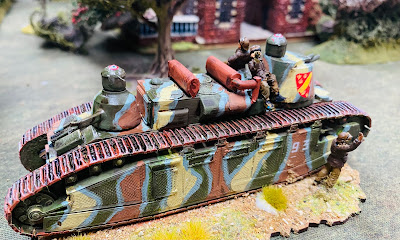
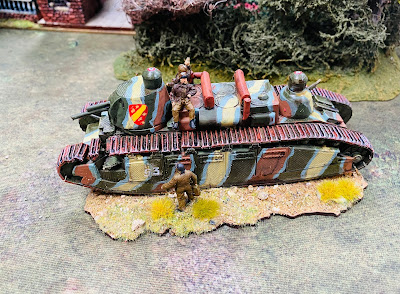
More Displacement Activity - France 1940 and a Monster!

This monster is a Char 2C super heavy tank. Info here. Only 10 were built, (No.93 was named Alsace). They were mobilised as a single unit, the 51st Tank Battalion. The unit never saw action as they were essentially crap for a whole list of reasons. All bar one were lost or destroyed by their crews as they were withdrawn to safety, but No.99, Champagne, was captured more or less intact and taken to Germany. 

Thankfully for me someone else is a bit of Francophile when it comes to their early WW2 tanks and I picked up this slightly damaged 3D print a while back. 

Crew take a rest and slug some wine while tank is fixed.

It arrived with some track damage so I thought I’d not repair it all to represent the throwing of a track. 

The tank is 1/72 scale, as are the crew ( there were 12 in total) who are dwarfed by 
Champaign after its capture by the Germans in June 1940.