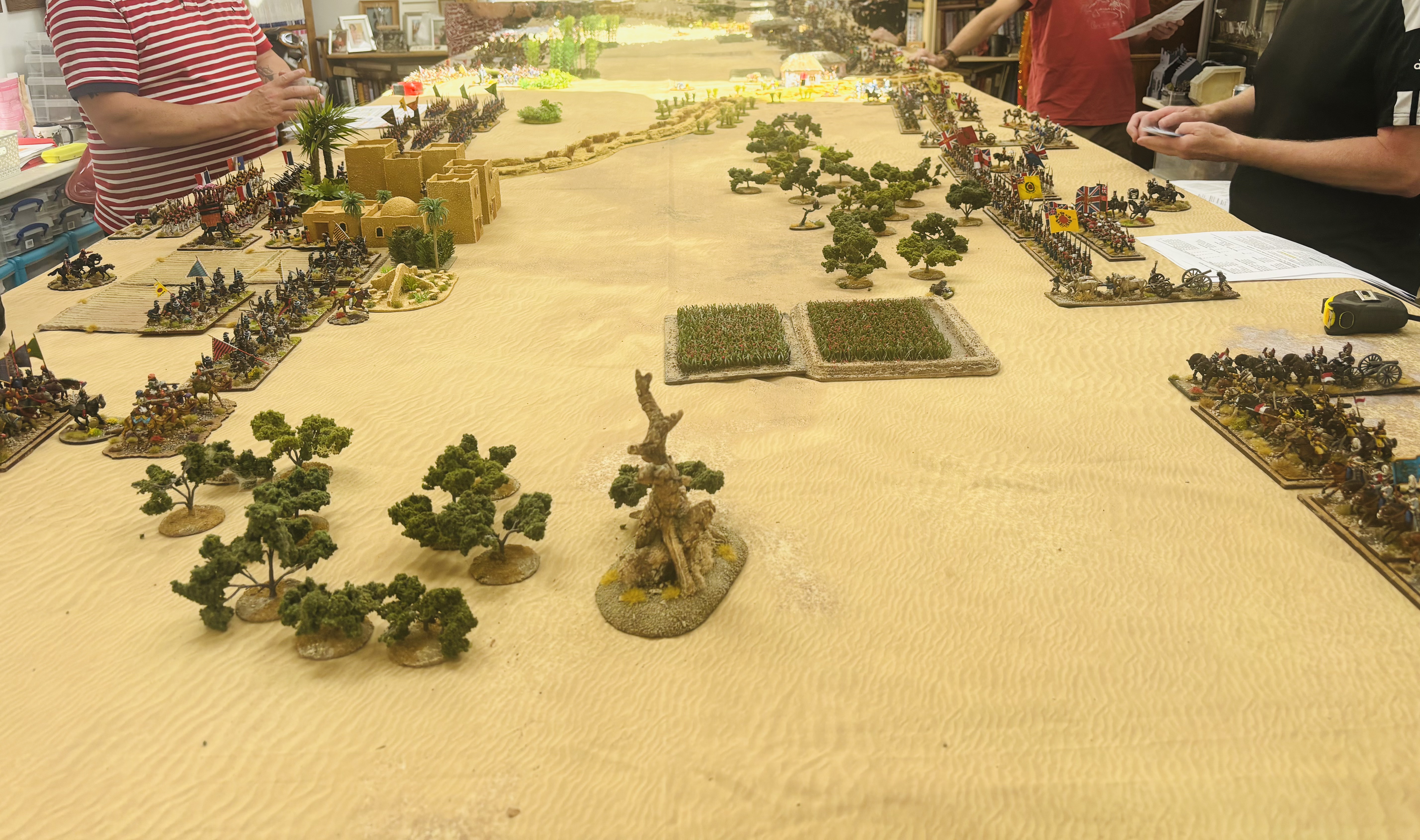
I had a few of the Burrowers over on Saturday to play a Sikh Wars game. I don’t think I’ve had these on the table for almost two, years which is a great sin; when setting the game up I was reminded how gorgeous the collection was - ok I am biased but it is striking and wish I could still paint that consistently well. Thank you Covid as this collection was born of the pandemic. I decided we should use Valour and Fortitude as there was a tested set of army sheets on the V&F Facebook page and I enjoyed the game last time when we were in a swampy Paraguay.
The British were following a withdrawing Sikh army. The latter chose to make a stand around a small town and behind a dried up nulla and a long stretch of jungle. For the British to win they had to break more than half of the Sikh brigades and capture the town.
John the Red and Nigel played the British while Richard and Jon were the Sikhs. The latter deployed with their Gorchara cavalry and camel guns split between each wing. One brigade of regulars held the centre, while a mass of irregular infantry were placed beside the cavalry on the Sikh left. A large mob of Akali filled the gap between the town and the cavalry on the right. The best Sikh infantry (the elite French-trained battalions) were held in reserve. Several batteries of guns were placed along the front. There was also a surprise waiting for the British as their scouting had been dreadful. Unseen by the British at the start was an emplaced battery of heavy guns immediately to the front of the town, which would only be placed on the table when it became possible to see it.

The British also split their cavalry, one brigade on the right and the other on the left. The left brigade contained the only Queen’s regiment of cavalry. The four infantry brigades were spread across the entire front , two heading for the jungle, one towards the nulla and the other on the far right. They were supported by what artillery was available, namely a few troops of Bengal Horse Artillery, Bengal Foot Artillery and a battery of heavy guns accompanied by a rocket!
The battle began with a general advance along the British line, although the troops on the right were somewhat slow in getting into position. I’m not going to give a blow-by-blow account of the game, but hopefully readers may be able to make sense of the photos.
 |
| Sikhs on the left, British on the right |
 |
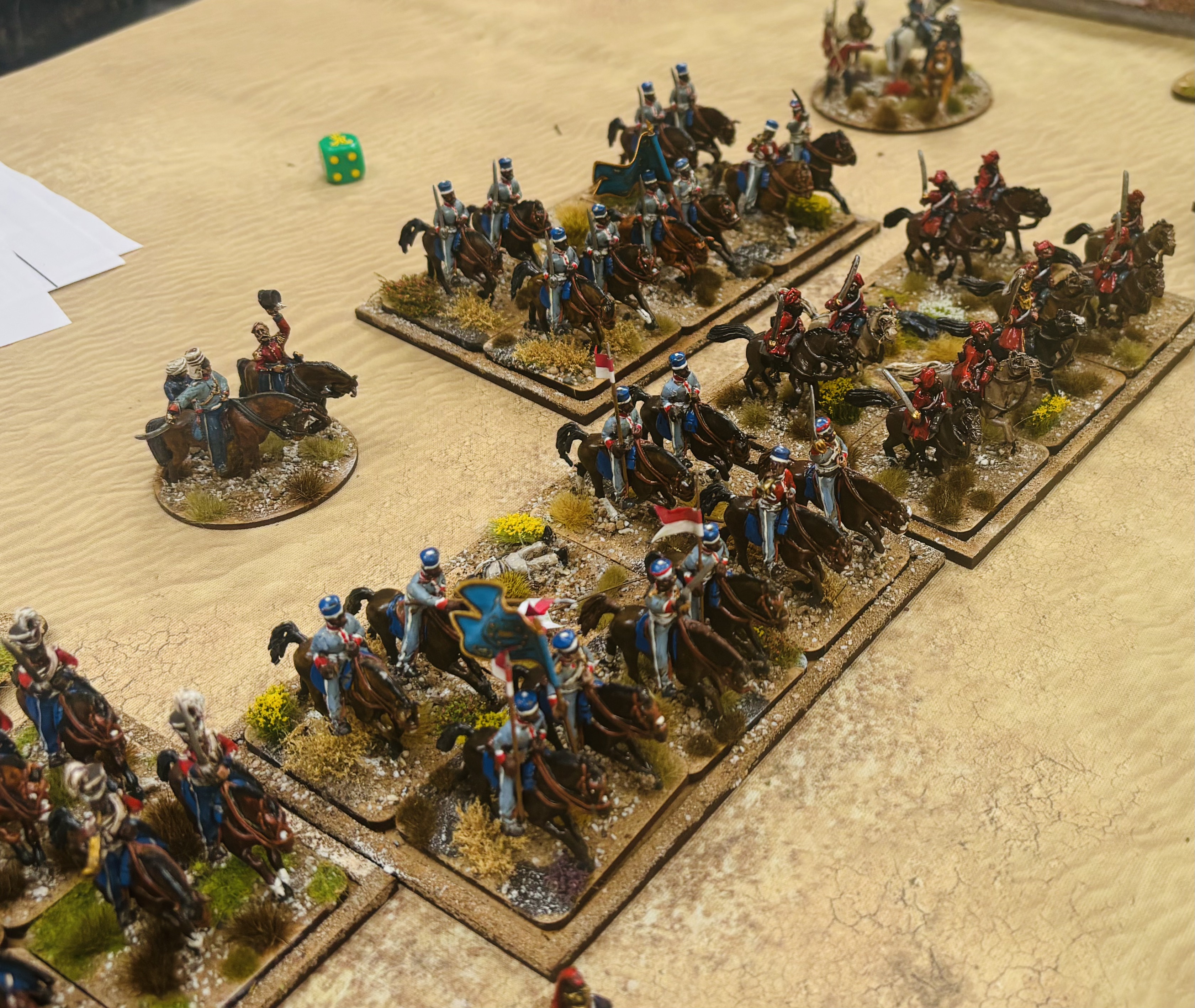
| British cavalry brigade on their right. No European regiment, just the Governor General's Bodyguard, two regimenty of Bengal Light Cavalry and one of Bengal Irregular Cavalry, with a troop of Bengal Horse Artillery in support. |
 |
| The Sikh centre. Six battaliopns of Khalsa with lots of guns. |
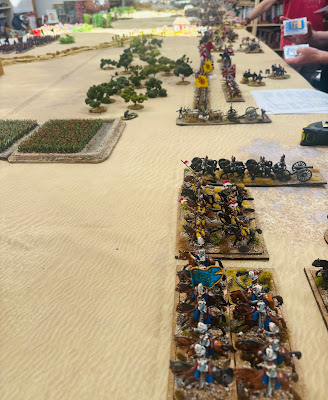 |
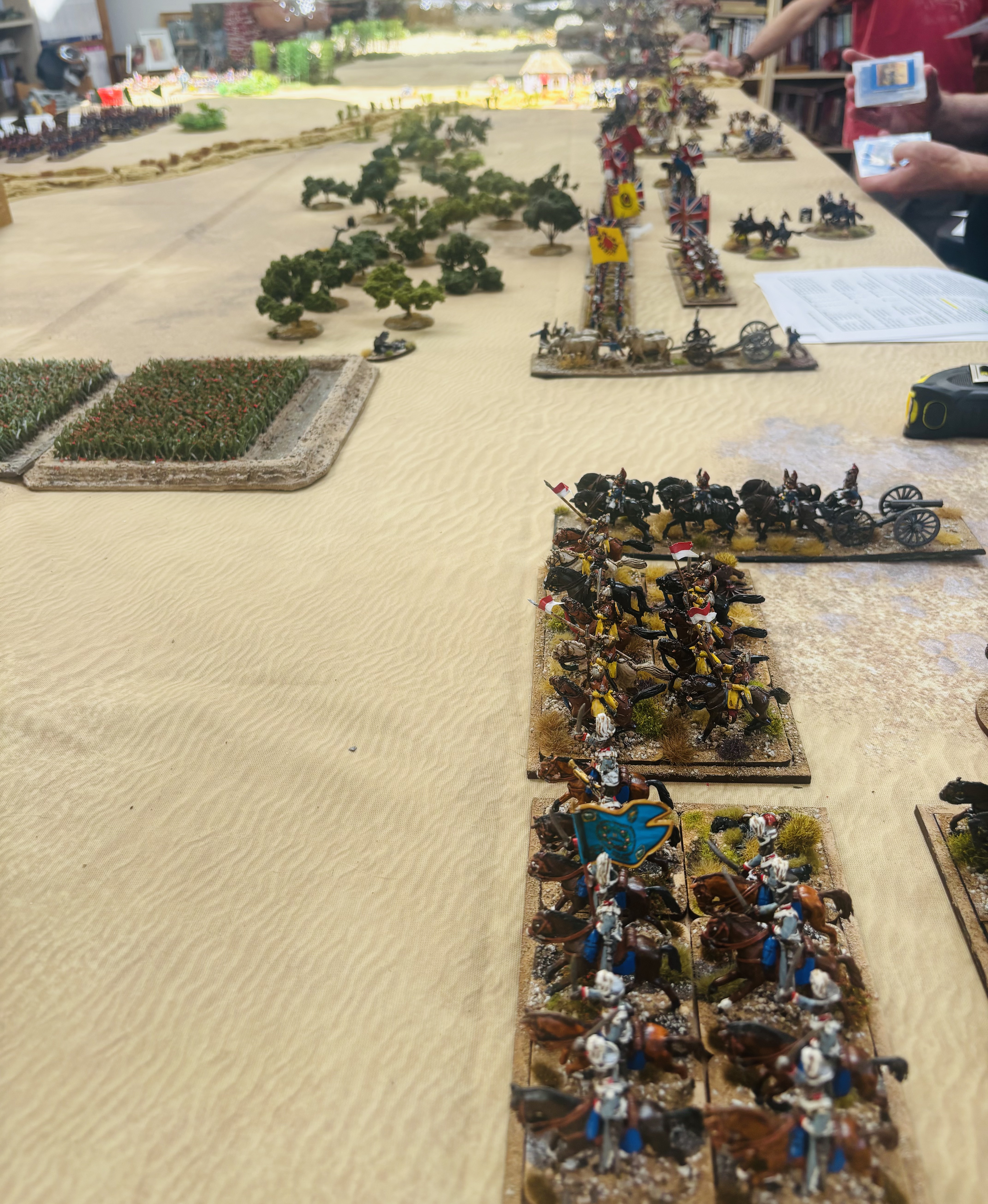
| The British left, with their other cavalry brigade, this time including European light dragoons (HM 4th) a regiment of BLC and the 2nd Bengal Irrrgular Cavalry. |
 |
| Lurking behind the town were several battalions of elite (French-trained) Sikh infantry and more cannon. |
 |
| Nigel wisely lurked in the undergrowth for a little while rather than face three heavy Sikh cannon. |
 |
| The cavalry on the British right were soon in action, getting the better of hoards of Sikh Gorchara cavalry. |
 |
| The biggest threat to the British centre was in theory four units of Akali irregular and fanatical infantry. Richard couldn't get them to move for a coiuple of turns. |
 |
| Bengal Horse Artillery about to bombard the Akali. |
 |
| There was also a fierce cavalry fight on the British left. This is the second stage of the combat as HM 4th Light Dragoons had already defeated one enemy unit and charged on into another. Ultimately the Sikh cavalry were disposed of, just as the Sikh reserves made their appearance from behind the town. |
 |
| The nulla proved to be a help and a hindrance to both armies. Troops descending into the nulla could not be seen but their was no guarantee that they could see out without first climbing back up the other side. At least that saved one Queen's battalion from the attention of Sikh artillery which was forced to target the Gurkha battalion to its rear. |
 |
| Nigel's brigades launched an assault on the Sikh redoubt and captured it more easily than I had thought possible. Rules tweak required I think? |
 |
| On the British right Jon and John launch their cavalry at each other, and ther Sikhs were able to catch and overrun a troop of artillery that was unable to get away. Most of the remaining Sikh horsemen were destroyed or driven back. |
 |
The horse artillery were unable to prevent the Sikhs from overrunning their position.
|
 |
| With the Sikh cavalry now rendered ineffective the British cavalry made several fruitless attacks on the irregular infantry to their front. All were surprisingly beaten off, causing more than a little consternation. Jon kept throwing 6's when testing to see how 'unpredictable' his men were, resulting in their stats being bumped up. |
 |
| Even the British infantry brigade struggled against the irregulars, loosing one battalion of Sepoys |
 |
| Zumi our Persian kitten inspecting the town. |
 |
| Finally the 'Avitables' .emerged from behind the town, |
which was now in the hands of the British
 |
| The Akalis were anihilated. |
 |
| The Sikhs tried to recapture the town but weree unable to gain a foothold. |
So there ended a very close and exciting game. I declared it a British victory, just. The town was captured and much of the Sikh cavalry and the Akalis had been destroyed, as had several regular battalions ikn the centre. There was certainly a much bigger 'dead pile' behind the Sikh lines!
V&F worked well. There were a couple of amendments which certainly made a difference, insofar that Sikh artillery HAD to engage in counter-battery fire, and any losses taken by a European battalion could be shifted onto a sepoy battalion in the same brigade. I was surprised the Sikhs held back their best infantry until it was too late, and I don't think Jon's brigade in the centre needed to advance, as it put them at a disadvantage against the British hiding in the nulla. I could be wrong of course. I need to add a rule for Sikh artillery when defending their guns in melee, and I wonder if the tenacity of these big batteries should be increased.
Anyway, it was an enjoyable game. Even the weather made it feel like we were in the Punjab. (Not really but it was very warm and humid).
I think I will try GdA II with the Sikhs next time. Not because I don't like V&F (which I do and are perfect for most big Saturday games here) but because I am curious.
Right, back to Paraguay for a while as these ships won't paint themselves!