Showing posts with label Mahratta Wars. Show all posts

Saturday, 1 April 2023

Serangapatem Fortress

Thursday saw us head south to Serengapatem and Mysore. Just over two hours by car on a very good road/motorway. Much warmer in Mysore than Bangalore but not unbearably so - mid to high 30sC so very pleasant if somewhat airless and humid. The fortress was stormed in 1799 by the British and their allies from Hyderabad after a siege lasting from 4 April to 5 May, which is one of the hottest times of the year. Tipu was killed and that marked the end of the Fourth Anglo-Mysore War. The fortress was pretty much demolished during the siege and the central area now houses a small town along with local police married quarters. Enough is still standing to get an excellent idea of what it must have looked like. 


Dungeons where Tipu kept his captive English officers.


A depiction of the death of Tipu Sultan during the storming of Serengapatem.
The Water Gate where Tipu was killed. ( see photo above)


We also visited Tipu’s palace across the road from the fortress, which will be the subject of another post, as will the visit to the Madras Palace in all its pure Victoriana finery. I have a few good ideas for terrain items, such as paddy fields and sugar cane fields. How I’ll do the latter I just don’t know yet. 

Tuesday, 7 September 2021

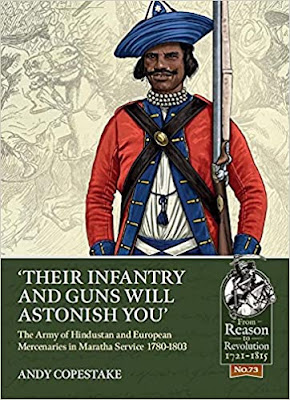
‘Their Infantry and Guns Will Astonish You’


Reason to Revolution No. 73, ‘Their Infantry and Guns will Astonish You’ - The  Army of Hindoostan and European Mercenaries in Mahratta Service 1780-1803 is, coming hot on the heels of ‘Bullocks, Grain and Good Madeira’, a prime example of famine to feast in terms of new books from Helion covering aspects of the military history of India and the ascendency of the Honourable East India Company (HEIC) at the end of the eighteenth and start of the nineteenth centuries. 

I don’t know about their infantry or guns being astonishing but this book certainly is! This is author Andy Copestake’s first book and it’s an absolute cracker! This is a period of Indian history about which I knew very little, being focussed more on the Sikh Wars and after. Having had the opportunity to read this book I found myself becoming more and more enthused with doing further reading on the subject. I’m amazed at just how much information and detail is packed into these 200 or so pages, and I really couldn’t have asked for more in terms of getting understand the history of European-trained and led troops under the Mahrattas. These so-called 'Trained Brigades' were raised in response to the amazing successes of the European-led troops fighting for the HEIC where traditional native forces were scattered with apparent ease by vastly inferior numbers of troops. The book uncovers a wealth of information on the formation of these brigades in response to the threat posed by the HEIC, and focusses on the the most successful of these formations, the Army of Hindoostan, starting with just two battalions in 1784 but increasing to a force of 30,000 men and 200 guns led by the Savoyard mercenary Benoit de Boigne and fellow European officers including Scots, English, French, Irish, Italian, Dutch and Germans. We are treated to an extensive, detailed and completely fascinating account of the history and campaigns of this formidable force and some of its commanders, where victory after victory was won against other native Indian forces until their defeat at the hands of the British at Assaye, Delhi and Leswaree.

Of course, the author also describes the organisation, orders of battle, armament and uniforms of these troops, as well as giving us an insight into who these enigmatic European soldiers of fortune were. There is some particularly interesting information on troops' pay scales and on supply arrangements. As always, the contemporary anecdotes and excerpts of letters that are scattered throughout the book are an attraction  for me as they give a little life to the overall (excellent) narrative.

The book is well written, clearly the result of a tremendous amount of research through a vast range of primary and secondary sources. It is lavishly illustrated with numerous contemporary black and white images, a good number of maps and eight pages of some of the most gorgeous colour images I've come across in a Helion publication for some time. I don't know what it is (probably my vivid imagination) but some of them, for example plates 'v', 'vi' and 'viii' almost seem alive. The book concludes with yet more invaluable information, with a list of the officers of the Army of Hindoostan and when, in what formation they served and their fate if known, as well as an outline of some of the other European-led formations in the service of a wide selection of Princely armed forces. The glossary will be useful for anyone not familiar with Indian terminology.

Overall then, Helion and the author are to be commended on producing such an enjoyable book on such a fascinating subject and I can wholeheartedly recommend it to anyone with any interest in the subject.


Thursday, 12 August 2021

Bullocks, Grain and Good Madeira - the Mahratta and Jat campaigns 1803-1806

Deep down in the recesses under my games table I have a large box full of unpainted figures for this campaign, Europeans, Sepoys and Mahrattas, the full shebang. I bought them when there were some silly “ignore ‘em at your peril or regret it!” sales from AW Miniatures. I wasn’t planning on doing anything with them for six months or so but this book might (will) just tip me over the brink of sanity and derail my ‘plan’ if I’m not careful. I can always rope in a load of my Sikh irregular infantry and cavalry to pad the numbers out……

This is one of the latest books in Helion and Co’s excellent and growing ‘From Reason to Revolution’ series. ‘Bullocks, Grain and Good Madeira, the Mahratta and Jat Campaigns 1803-1806 and the emergence of an Indian Army’ is another subject about which I have a great deal of interest but not the in-depth knowledge I have of other periods and campaigns. 

The book is well written and after a brief chronology to help put everything in context within a wider world, not just in India,the various troops types, ie the Europeans (Crown and Company), East India Company Native Sepoys and the Mahrattas, are discussed, with details relating to dress, training, effectiveness and organisation. This was the period when the Presidency armies of Bengal, Madras and  Bengal were coming of age as an ‘Indian Army’ in the eyes of the Crown and the East India Company. The information relating to the European-trained and led sepoys in the Mahratta armies is especially useful, and these hard fighting troops were to prove to be more than a match for the ‘British’ forces facing them. This section is underpinned by the excellent colour plates in the centre of the book that provide us with some great example of uniforms of the regular troops and the various states of dress of the irregulars. Many of the plates are taken from private or public collections, and all are excellent depictions of the regular and irregular troops  engaged in the campaigns, but four pages contain gorgeous originals by Patrice Courcelle.

The narrative then takes us through each of the campaigns, in the Deccan, Hindustan and the Holkar and the failed siege  of Bharatpur. The focus is very much on latter, plus the battles of Assaye, Argoan, Laswari and the fighting outside Delhi receive good coverage. Some detailed maps of the manoeuvres during the campaigns and major engagements are very helpful when following the course of events, as are the orders of battle. As usual the use and inclusion of quotes from primary sources is enlightening and helps draw one into the narrative.

At the end of the book are three excellent detailed orders of battle; one for a relative newcomer to the history books called Wellesley and his army at Assaye,  another for the Grand Army of the Doab under General Lake, and sandwiched between the two, one for the regular army of the state of Gwalior. 

Overall I found this book full of useful information, clearly well researched and presented in such a way to allow the course of the campaigns to be followed easily for a relative novice to the subject like me. The supplemental stuff regarding uniforms and organisation is useful, although whole books could be (and have been) written on the subject! I’d recommend this book both for anyone wanting an introduction to the period and to wargamers interested in refight of the wars.