Showing posts with label Seven Years War. Show all posts

Tuesday, 17 February 2026

French Infantry During the Seven Years War , Volume 2, Part 1.

My health at present is such that the best I can do for anyone reading this to be entertained is another review. 

Jean-Louis Vial has produced another solid and quietly impressive volume, the sort that rewards anyone with even a passing interest in the French Army of the mid-eighteenth century. This second instalment, French Infantry During the Seven Years War 1756–1763 volume 2: Regimental Distinctions and Colours; Part 1: French Regiments No. 1 to No. 74, covering regimental distinctions and colours for these regiments, continues the meticulous approach of the first book but feels even more assured in its presentation.

Vial’s strength lies in clarity. He manages to make a potentially dry subject—buttons, lace patterns, flag variations—surprisingly digestible. The organisation is clean, the detail is steady rather than overwhelming, and everything is backed by careful research. It is simply reliable, well-evidenced, and easy to use.

The colour plates and uniform artwork are, as expected, one of the highlights: crisp, attractive, and immediately useful for painters and wargamers. In fact with 32 pages of colour illustrations of each of the regiments’ uniforms and ensigns, we have something of a jackpot of detail to feast upon. However, the accompanying text is where the book earns its keep, guiding the reader through a complicated maze of uniform evolution without ever tying knots in one’s brain, well almost in my case. The uniforms of each regiment are discussed in some detail which complement the splendid regimental illustrations. There is even a concise service history for each regiment.

All told, this is a thoughtful, well-constructed reference that delivers exactly what it promises—and does so with quiet confidence. A pleasing addition to the shelf for anyone drawn to the Seven Years War or the ever-fascinating tangle of French regimental history.

This is No.151 in Helion’s from Reason to Revolution 1721–1815 series.


ISBN: 978-1-804515-40-2                    114 Pages Paperback


Saturday, 22 November 2025

Frontier Soldiers of New France 1683–1760 Vol 2


Another Helion book arrived a couple of weeks ago — this time Frontier Soldiers of New France, Volume 2 by Kevin Gélinas. Like the first volume, it’s beautifully produced and absolutely packed with detail, but this one takes things further into the real life of the Compagnies Franches de la Marine and other colonial troops in New France. Unlike the first volume it is not co-authored by the late Rene Chartrand, but his influence is apparent.


Gélinas goes beyond just discussing regulations and standard gear, offering insight into how soldiers truly lived and fought—think snowshoes, moccasins, and tough leggings. The book provides an intriguing perspective on the ways European military practices adjusted (or sometimes failed to adjust) to the North American wilderness. Each chapter tackles a different aspect: from campaign clothing and gear for summer and winter, to cookware — like the curious ‘marmite cooking pot’ which I will not explain here — and shelters, bivouacs, and even officers’ unofficial equipment choices. The illustrations, photos, and colour plates are top-notch, making this resource invaluable for wargamers, modelers, and reenactors alike.


If you enjoyed the first volume then this is for you. It’s another cracking addition to Helion’s From Reason to Revolution series (No.145 in fact), and essential for anyone interested in the French and Indian War or the colonial frontier of New France. Highly recommended.


ISBN: 978-1-804516-79-9                227 pages, paperback.

Thursday, 20 February 2025

French Infantry During the Seven Years War 1756-1763 Vol 1

At the risk of being boring here is another review for your delectation as I shift my painting focus from 1940 France to something a little more exotic....

I’ve had this book for some time and have only now finished reading what to me is a good guide to the organisation of the French army during the Seven Years War. French Infantry During the Seven Years’ War 1756–1763 Vol 1 by Jean-Lous Vial is number 137 in Helion’s splendid ‘from Reason to Revolution’ series. 


The book looks at the organisation and evolution of the French infantry regiments during this period. The author examines in some detail what made a French regiment ‘tick’, that is, the hierarchy, the recruitment of soldiers and their training, officer training and career prospects, housing, uniforms and equipment. There are also separate chapters devoted to the Provincial Militia the Grenadiers Royeaux and the Coastguard Militia; indeed these last three were my favourites.


The author has used a comprehensive range of primary and secondary sources, and he makes good use of contemporary correspondence to illustrate the narrative. The book also contains a number of black and white illustrations, largely contemporary or near contemporary. There are also eight full-page colour plates of a variety of French infantry soldiers drawn by the talented Sergey Shamenkov. 


This book certainly has something to add to what is already available on the subject, much of which is now quite dated. This more recent examination of the French army is therefore a valuable new look and I would recommend it to anyone interested in this subject. I also look forward to the next two volumes in the series.


Shame I sold all my SYW collection (including my lovely French army).......maybe not.


ISBN 978-1-804514-36-8.          166 pages, softback


Monday, 2 December 2024

Goodbye Seven Years War


Six big boxes containing 26 really useful boxes of figures and weighing in at 129kilos. 97,329 polystyrene blobby things to cushion the several thousand figures. 

Picked up today and on their way to my mate in Switzerland.


Tuesday, 18 June 2024

The King and his Fortresses


This recent publication from the Helion stable is more than a little niche but no less fascinating for that. Frederick the Great must be one of the most written about figures of the eighteenth century, but this examination of Prussian permanent fortifications during the period 1740 to 1786 by Grzegorz Podruczny is definitely something that takes in a very different perspective of the king and warfare during his eventful reign, and is not an angle I have encountered before. The author is well placed to provide us with the definitive account of Frederick and his policy towards fortresses within the kingdom having researched and written on the subject in depth over many years.

Much of the first part of this rather large book focusses on the Prussian state during Frederick’s reign and the science of fortress construction and siege warfare. This does well paving the way for the comprehensive  description of Prussian fortresses during the Silesian and Seven Years’ Wars. This is the true heart of the book and is a tremendously detailed analysis of the subject. 

The book contains a large number of contemporary and modern day black and white illustrations and drawings, as well as several photographs of surviving fortresses (or surviving parts of them at least) and these certainly help focus the reader on illustrating and understanding the complexities of fortress building and indeed siege and counter-siege warfare. For anyone wishing to delve deeper into the subject the author has included an impressive bibliography.

Overall, this is a book that will satisfy the interests of readers with an interest in eighteenth century seige warfare and fortress design and construction, whether it be focussed just on Frederick of Prussia or on a wider basis across Europe. I found this to be a very interesting and not too technical read, and one where I felt my knowledge and understanding was definitely improved. 

ISBN978-1-804514-35-1  softback, 383 pages


Monday, 8 May 2023

Anniversary game: The Battle of Prague 6 May 1757

Well. Here I go again, back from our jaunt to India, in another anniversary refight of a famous Frederickian victory which has yet to be repeated on my wargame table over the years. 

Despite or perhaps because of the coronation we had an almost full house. Conrad, Shaun and Nigel were the Austrians and John the Red, Dave and Paul the Prussians. I umpired. We used Black Powder with our normal changes to the turn sequence (Initiative/Shooting/Commanded Moves/Melee which everyone believes gives a better game. Hopefully these photos will give a flavour of how the day went. 

Silly and anachronistic hat time for the Prussians.

The battle at the start of the action. All the cavalry in the far distance, with the thinly held heights on the right, reinforcements on the way.

The Prussian army has marched to turn the flank of the Austrians and caught it napping. The Austrian commander Charles of Lorraine reacted to the Prussian manoeuvre and his cavalry had made it over to cover the right flank of the army, and some artillery and combined grenadiers were already on the heights, with more Austrian infantry following closely behind. The clock was ticking for the Prussians who had the unenviable task of gaining the ridge and defeating the Austrian infantry while hoping that the Prussian cavalry could at least slow down if not defeat the superior Austrian horsemen to ensure the infantry had the time and space to carry out their battle winning objective. All the Austrians had to do was ensure their cavalry beat the Prussians as quickly as possible while the infantry raced to reinforce the troops holding the heights. In the previous refights of Prague the Prussians had been unsuccessful so their hopes were high for a final chance of victory. The Austrians won the initiative so got to move first. In retrospect the Prussians should have automatically won the initiative due to the scenario but I just went with a dice off with plus one to the attackers, who still lost. That might have been a clue for setting the scene for how the game developed. Read on….

The heights, thinly held by the Austrians at this stage. The Prussians can be seen massing in the distance.

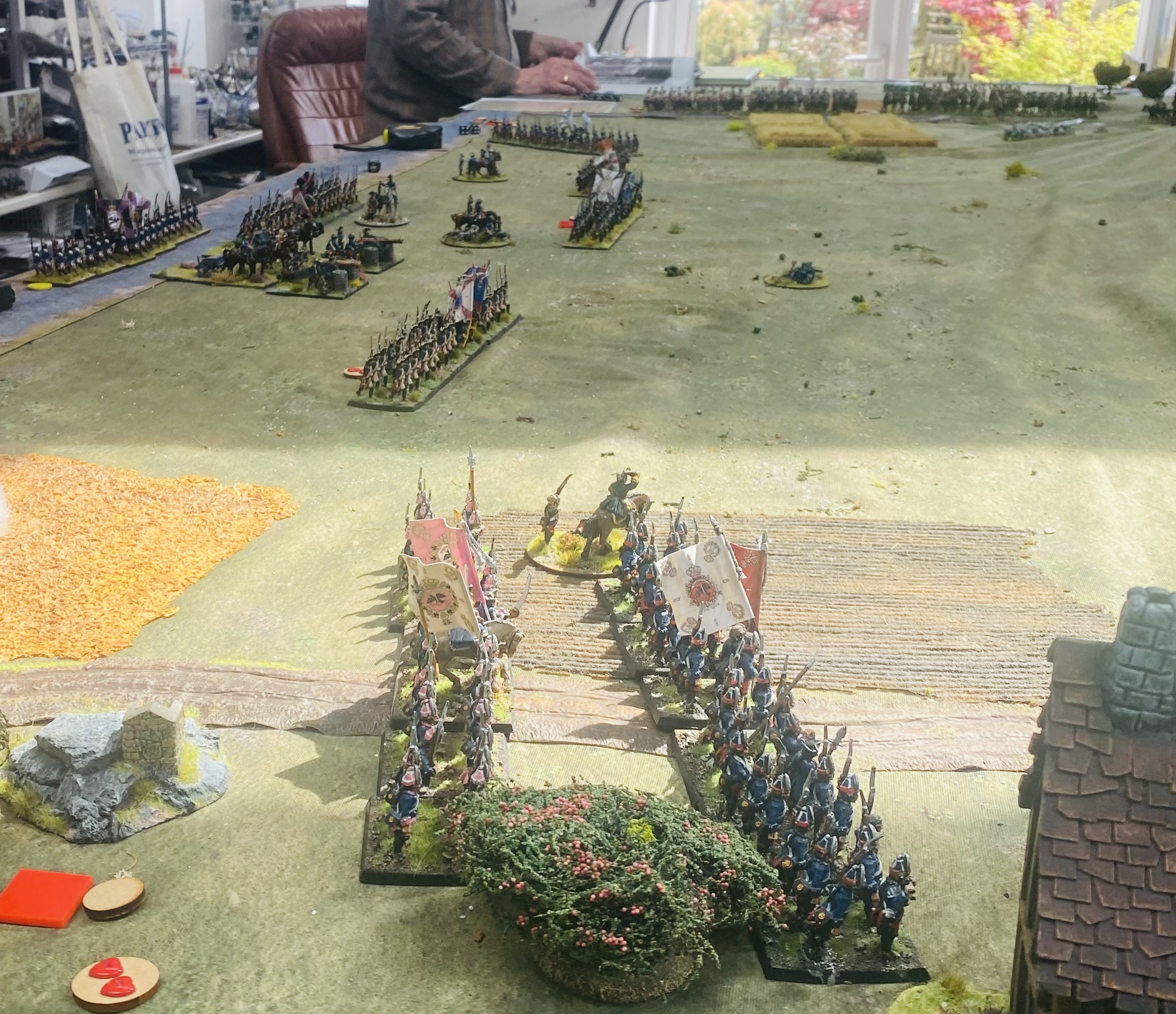
The Prussian attack spearheaded by their grenadiers and best regiments about to take fire from the Austrian artillery and infantry.

Shaun ordered one of his battalions on the heights to charge the Prussian grenadiers. It all went terribly wrong and they were broken by a combination of closing fire and cold steel. Could the gap be exploited?


As noted earlier, the Prussian first turn had seen the leading brigade get three moves which they duly took, leaving them right under the Austrian guns. They were also unsupported as the second Prussian brigade had not arrived on table, so they were dangerously exposed and were to pay the price for their enthusiasm. Marshall Schwerin was in command of the leading brigade and as in the real battle he was cut down during the attack, leaving the brigade leaderless.

Austrian reinforcements - in the nick of time I’d say!

With their first assault on the heights driven back the Prussian reserves make a belated entrance onto the table.

More of the Prussian reserve brigades.

Meanwhile over to the cavalry. The Austrian move had the Prussians  backed up against the edge of the table, which was not good.

Seemingly endless numbers of Austrian cavalry lined up to drive the Prussian cuirassiers and dragoons off the battlefield, which they duly did!

Austrians rally after defeating the Prussians. At the cost of one brigade broken they had destroyed all of Paul’s heavy cavalry - reminiscent of the Kolin refight a couple of months ago.

Austrians manoeuvre to be able to roll up the flank of the now exposed Prussian infantry.

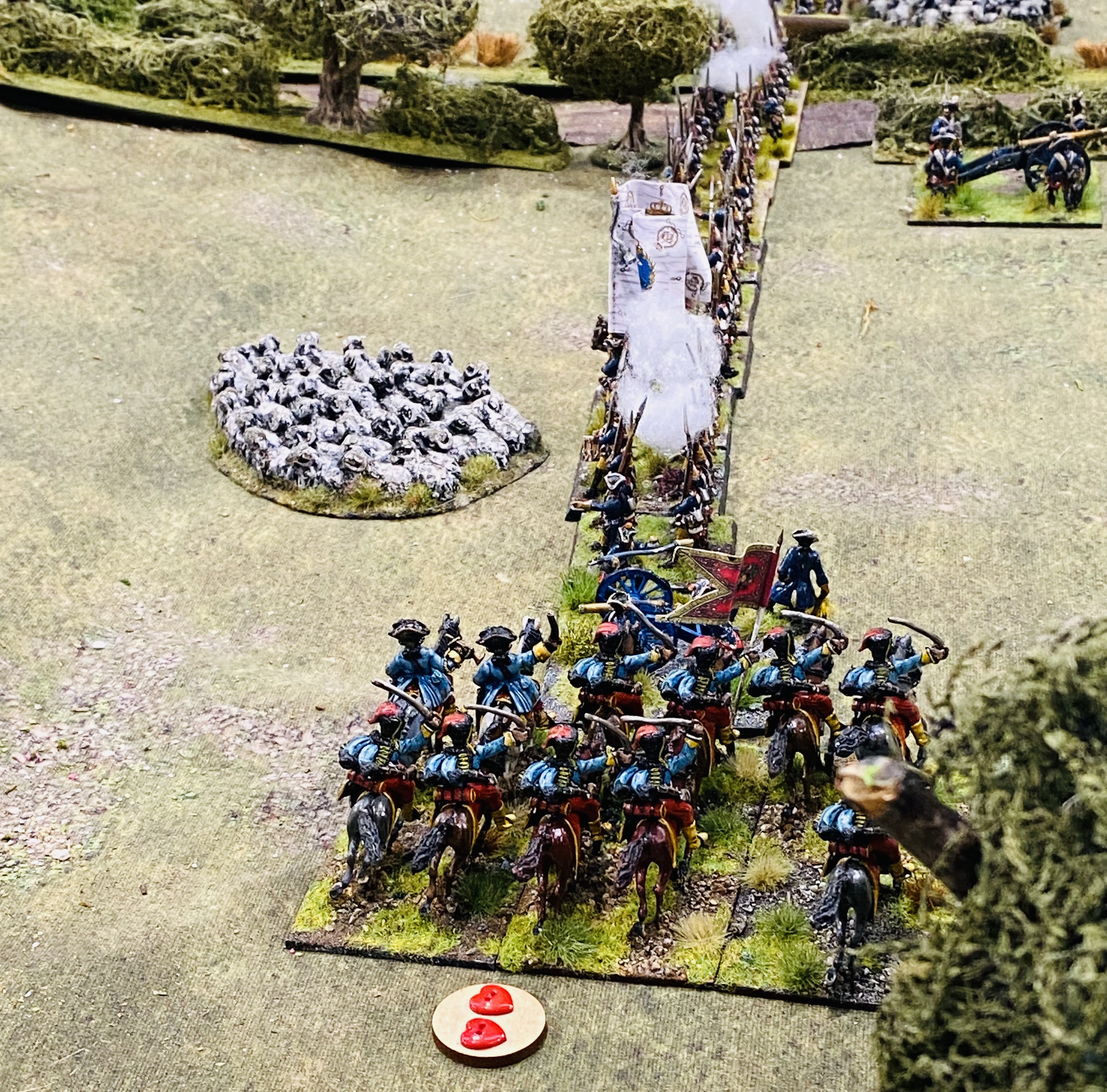
A futile charge by two regiments of Prussian hussars failed to even reach their target and  canister from the pair of 6-pdrs broke both units.

The last of the Prussian reinforcements who will be able to cover their comrades’ retreat.


We were actually in danger of finishing before lunch so catastrophic was the defeat of the Prussian cavalry. Thankfully the Prussian infantry threw itself against the Austrian army and were blasted back from whence they came. Mutiny in the rank of the Prussian command saw the attack fizzle out as a sense of defeatism grew in the ranks. Even direct orders from Frederick (Dave by tradition is always Fred) were disregarded. All the Prussians could do was admit defeat and retire.

Now then, were he not already full of grapeshot on the slopes he failed to capture, John the Red would be en route to a damp dismal prison fortress somewhere on the Baltic coast for his insubordination.  This is a really difficult one for the Prussians as they really must hold the Austrian cavalry long enough for their infantry to get to grips with the Austrians. I admit I probably should have allowed the Prussian reserves on earlier, and I ought to have made all the Prussian commanders rash and build in some rule where the Prussian infantry have to attack regardless of the circumstances. Maybe next time?

Anyway, a great game to mark my return from holiday. I think everyone enjoyed themselves, although perhaps the Austrians enjoyed the outcome more.


Sunday, 8 January 2023

"I think the King will lose this day" said Marshall Daun before Kolin. Was he right?

The first game of the year was played out yesterday, a large refight of one of my favourite Seven Years War battles, Kolin. It was a full house, and Conrad, Richard, John the Red and Nigel were the Austrians while Dave, Paul, Shaun and John H were the Prussians. I decided to use Black Powder with some of our usual house rules.

Notes on terrain. Troops shooting through or into the standing crops did so at -1. The hedgerows and tracks are representing sunken lanes. Troops in the sunken lanes benefit from cover but if behind the hedges themselves they do not. 

The game about to kick off. Prussians looking worried on the left. Austrians also looking worried on the right.
The bulk of the Prussian army is either not yet on the table or strung out in column along the road, overlooked by the Austrians to their right. Shaun anxiously looking over his right shoulder towards their reinforcements.
The Austrian left wing. Thankfully for the Prussians these troops were not allowed to activate until turn four, or if the Prussians came within 24" of them.


The Austrian centre from their rear. Grenz and a lone battalion of grenadiers and a battery of artillery.

On the Prussian left, their hussars quickly became embroiled in combat with their Austrian counterparts.  By turn two the Austrians had defeated all four regiments of Prussian hussars thanks to some unusually bad dice scores from Paul, although the Austrians would say it was down to their tactical brilliance!
The flight of the Prussian hussars left the flank of their attack exposed and open to attack. The Austrians charged but superior discipline and some better dice rolls meant the Prussian grenadiers beat off the enemy attack, although their supporting artillery was overrun.

The Austrians tried to exploit their victory against the Prussian left but were countered by a brigade of Prussian cuirassiers. Sadly for the cuirassiers, by this time Nigel had brought his Saxon cavalry and attached Austrian elites forward, and the Prussians were pushed back and broken. 

In the centre after a delay the Austrians finally got their troops to move in order to counter the Prussian onslaught in the centre.


The Prussian attack in the centre captured the old Swedish earthworks and drove most of the Grenz out of their positions.

I should have expected this move from Conrad, as two brigades of heavy cavalry posted behind their left wing rapidly advanced against the Prussian right and suddenly surged forward for three moves as he'd thrown something ridiculously low. Eight regiments is a scary sight.

The presence of so much Austrian cavalry meant that the remaining Prussians due to arrive along the road were delayed and at no little risk once they appeared. The lead battalion (IR 15 Garde) did deploy to cover the entry of the rest of the brigade. They did not shoot such a tempting target as we only allow infantry to move once and still fire.

John H and his remaining troops arrived a turn late, which was to prove a critical delay.

Conrad's cavalry swept away a brigade of Prussian dragoons and a lone cuirassier regiment and galloped along the enemy baseline, pursued by John H's infantry and cavalry. 

The Austrians were held up by the valiant efforts of IR40, who survived a flank charge, reversed their rear ranks and prepared to sell their lives dearly. 

John's Prussians advanced against the Austrian left wing under Richard,  ignoring the threat of enemy cavalry to their rear as four regiments of Prussian cuirassiers had just arrived.
                              
The Prussian right, with Conrad's Austrian cavalry in the distance behind the Prussian lines. 

Austrian and Saxon horse on the Prussian left.

The Prussian left, crumbling under the pressure from the Austrians, and due to Paul's continued and statistically unfair dice rolling!
Austrian cuirassiers seen through a window in one of the villages they rode past.

John the Red's infantry made it to the sunken lanes and began trading shots with the Prussians. Attack over.

I did a quick roll call and it showed that the Prussians were in deep trouble. Their hussars and cuirassiers on the left had been destroyed and the infantry attack in the centre had been stopped, due largely to a dogged Austrian defence but also to the presence of enemy cavalry on their flanks and rear! Only on he Prussian right was anything going reasonably well, but it was too late. John H's infantry had driven back Richard's Austrian battalions and his cuirassiers had caught up with Conrad's roaming horsemen in the rear of the army. However, by now over half of the Prussian army brigades were in retreat, off the table or were broken and retiring. Many of the troops in the centre would be unable to retreat due to the Austrian cavalry and would be captured. In fact only John H had troops actually under orders!

All this and it was only 2pm real time, and after no more than six turns the Prussians had been comprehensively defeated. Quite an achievement but there was definitely something awry with the Prussian dice rolling yesterday. Conrad's mad charge around the Prussian army would probably not have happened or been as successful if he hadn't been able to get the three moves needed to cross the battlefield and thus delay the Prussian reinforcements. The Prussians needed these infantry to press home the attack but they had to do without them.

This was a splendid game and despite the early finish was thoroughly enjoyable. It was also a major boost to my gaming mojo after a couple of months of illness, uncertainty over my wife's health and a touch of le cafard. Black Powder worked really well again as usual. While not my favourite ruleset for the SYW they're easier to manage than, for example, Honours of War, where the alternate move and fire system for opposing brigades would have slowed things down significantly, and not everyone is familiar with Paul's Panoply of War set. Everyone is familiar with BP and they work for big games such as this.


Wednesday, 29 June 2022

The Battle of Rossbach 1757: New Perspectives on the Battle and Campaign.


When I saw this was soon to be published I thought, ‘oh, not another book on Rossbach’. Well, it is just that, and more, but with a different perspective which makes it all the more interesting than a simple regurgitation of previous accounts would be. Helion and author/editor Alexander Querengasser have pulled it off again with this book, ‘The Battle of Rossbach, 1757: New Perspectives on the Battle and Campaign’ with a refreshing look at the battle with contributions from six respected historians, each with a different angle to explore. The book was originally published in German in 2017 but this translation for Helion by Rick Sanders is well written and structured, full of useful information and a really engaging read (I read it in one sitting ending at three o’clock in the morning and fell asleep with pencil notes and post-its all through the book!).

The book is split into six main chapters, each, as I’ve mentioned earlier, covering a distinct aspect for investigation. First there is an excellent chapter covering Prussia’s army on the eve of battle, next is a favourite of mine covering von Sachsen-Hildburghausen and the leadership of the much maligned Reichsarmee. My favourite chapter is that on the French army at Rossbach. I do like the French army of the eighteenth century, despite it emerging from a series of wars with a somewhat tarnished reputation. Nevertheless this chapter provides us with a useful and detailed breakdown of the army present at the battle, and some handy information on it was organised, it’s tactics and how it’s defeat impacted significantly on the army in the future. Further chapters explore the battle itself, an interesting look at the role of Saxony and finally the battle as a place of remembrance.
As one has become used to, the book is illustrated with many contemporary black and white images and a central eight-page spread of glorious colour illustrations, many of which are reproduced from contemporary paintings. One two-page specially commissioned painting by Peter Denis depicting the Prussian infantry in action against the French cavalry is wonderful on the eye.

Going back to the beginning of this piece, this new look at the battle is a welcome one, from my perspective at least, and I am sure many others with an interest in the Seven Years War will be similarly excited about the book which is No. 88 in Helions from Reason to Revolution series.

Interestingly, I’ve gamed this battle three of four times and the Prussians (or proxy Prussians in one disguised scenario) have never won as convincingly as did Frederick,  never loosing but coming close to a complete rout of the French and Reichsarmee only once. 


Saturday, 1 January 2022

‘Like a Brazen Wall’ - an absolute cracker!

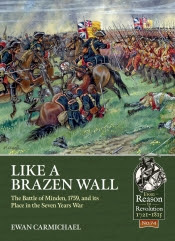
There seem to have been a number of books on the battle of Minden published in the last year or two to add to those that have been around for a while. I have read many books on the battle, most of which were pretty good, some much less so, but this latest from Helion in their ‘from Reason to Revolution’ series by Major General Ewan Carmichael must rank as one of best accounts of the battle I have come across to date. ‘Like a Brazen Wall, the Battle of Minden, 1759, and its place in the Seven Years War’ is a well written and meticulously researched account of this pivotal battle, famous to English readers for the heroic actions of a handful of British battalions and infamous for the shameful inaction of one Lord Sackville.

Of course even for the most patriotic Anglophile there was much more to the battle than these episodes alone, and the author goes into great detail with a comprehensive narrative covering the strategic and operational contexts, the events leading up to the battle as well as the battle as a whole. As would be expected the reader is given a useful description of the French and Allied armies and potted biographies of the commanders of both sides before examining the Allied plans, the preliminary manoeuvring, including the importance of the battle of Gohfeld in setting up the tactical situation, and a clear account of the battle itself, a breakdown of the casualties, and the battle’s aftermath. No book on the subject would be complete without mention of the court martial of Lord Sackville for his shameful behaviour during the battle. The courageous part played by the French and Saxon cavalry is also given fair consideration to provide some balance to the narrative. I found the chapter reviewing the war and the battle especially interesting, including as it does many contemporary or near contemporary reflections on performance. The section on the effectiveness of British musketry is well reasoned and fascinating.

Numerous appendices include detailed orders of battle, uniform details and Contades’ orders for the battle are reproduced together with a contemporary account by the Comte de Lusace. The author has used a wide range of primary and other sources when preparing this book, including many covering the French perspective of the campaign which gives us an insight and opportunity to consider into the plans of the French commander. The book is well provided for in terms of maps and the chapter on exploring the battlefield contains a goodly number of useful photographs of the battlefield today. There are also a dozen full page colour plates by the well known artist Patrice Courcelle. They are beautiful.

If you were to buy only one book on this battle then this is the one to get. In the meantime I shall now attempt to finish off my English Seven Years War army as  one of my 2022 projects. At least I already have the figures!


Wednesday, 17 November 2021

Hastenbeck 1757 - Review

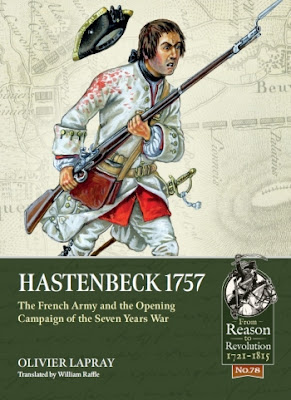
Hastenbeck 1757 is No.78 in Helion’s From Reason to Revolution series. Written by Olivier Lapray and translated by William Raffle it is an analysis of the French army and the opening campaign in the Western theatre of the Seven Years War.

In the east, Frederick of Prussia’s run of victories since Lobositz in October 1756 has only just been halted by his defeat at Prague the previous month. The battle of Hastenbeck on 26 July 1757 in Westphalia was a resounding French victory that almost knocked Hannover out of the war. This book focuses on the French army during this campaign, and does so in some detail. A short but useful introduction to the structure of the French army, it’s tactics and it’s shortcomings is closed by the sentence ‘Ultimately one could reasonably say that Marechal d’Estrees was….at the head of a large army but one that was not suited to pursue the war with energy’. Very true as there was much internal conflict between the army and the court/government that certainly muddied the waters operationally. The course of the campaign is described in detail, leading up to a fascinating account of the battle itself, which was a complex affair. There book contains a wealth of extracts from contemporary documents, which as ever bring the narrative to life, especially those referring to the battle itself.

The book is illustrated with some excellent black and white uniform prints and the centre pages contain a collection of colour illustrations, including several sumptuous originals by Patrice Courcelle. The narrative is also supported by a number of useful theatre maps as well as two of the battle itself showing the disposition of the troops involved. 

No less than eight appendices complete the book, which include detailed information on the orders of battle of the French Armee du Bas Rhin at the start of the campaign and at the battle itself, unit strengths, losses, and the composition of the massively outnumbered Allied army of Observation under the Duke of Cumberland. 

The French perspective was always going to be of great interest and this book does not disappoint. Well structured, it is a well-presented and detailed analysis of the battle and certainly a book that anyone interested in the Seven Years War should find useful.


Monday, 14 June 2021

This week’s game. Back to the Eighteenth Century.

This week I arranged an 18th century game using Black Powder for the Burrowers. It wasn’t based on anything in particular but I intimated that it was. I also took the opportunity to field some troops that had never yet had their baptism of fire, which turned out to be a mistake given the usual mantra that new units always run away!

The French were one of the belligerents. On the other was a combined allied force of English, Hanoverians, Brunswickers and Hessians. The French had more and slightly better cavalry and heavier guns, while the allies had a couple more battalions of infantry. Most of my French are Ebor WSS figures but there are some Cran Tara, Black Hussar and Foundry in there as well. I went with Ebor as I got an unmissable deal (working out at about 25 quid for a 40 figure battalion as I bought LOTS) and I thought I'd base the army around the French during the War of Polish Succession to account for their slightly out of date appearance. My toys so I do as I wish of course! The Allies are a mixture of (mainly) Cran Tara and  Minden with some Foundry and Warlord.

Paul, John and Nigel were the French while Neil (British and Brunswick), Richard (Hanoverians and English horse) and I ( Hessian and Hanoverian horse) were the allies. We used Black Powder 2 with my house rules, some of which we forgot of course.

Both sides were against the clock as there was a chance that either could be reinforced by a brigade entering in the flank of the enemy. This was decided by me rolling a dice each turn, adjusted depending upon how the battle was playing out, by which I mean that the side nominally loosing had a better chance to get reinforcements. In truth there were NEVER going to be any for either side but nobody else knew that. Tee Hee. Hopefully these photos, some of which were taken by Richard, give an idea of how the game played out.

The Allied line seen from
their right wing.
The stage is set for battle to begin.
The French left wing. Why on earth did I give them a redoubt?

A taste of things to come in terms of extreme dice rolling! Neil's first shot with his cannon scored four sixes! Their target, the Royal Italian were pulverised and forced to retreat. They never recovered.
This was me. I needed anything but a 1! 
Paul's first move on the French right was to launch his cavalry at the Brunswick brigade on our left. 

The Hanoverian cavalry brigade advanced towards the French  left wing.
Wave after wave of French cavalry kept the Brunswickers pinned down almost on the table's edge.
Slowly but surely the Brunswickers were being worn down.

Neil's Brunswickers were also attacked by French infantry. 
Yet more pressure on the poor Brunswickers (First time out on the table too!)

The Hanoverian cavalry brigade was beaten badly by a combination of French artillery, infantry and  some dreadful dice rolling on my part (see above for the 'anything but a 1' result). 


The French cunningly screened their best infantry (the Garde Français and a battalion of Swiss) with a battalion of the Gardes Lorraine, who obligingly soaked up a great deal of damage before being forced to pull back.

French infantry of the Bourgoigne regiment supported by the Irish Rooth battalion attacking the English brigade.

My Hessian cavalry were very slow to get up into action, despite having a '9' commander! They looked on as the Hanoverians were demolished.

The English cavalry were led by a '6' rating brigadier but Richard still got them to move into musket range of the French.


The Hanoverians blundered and assaulted the church. 
The blundering Hanoverian infantry brigade  attacked the Irish in the church. After one turn of melee they routed after a dire break test, taking another battalion with them in the process. That left this battalion rather exposed and the brigade almost spent.
The Hanoverian grenadier battalion had advanced to occupy the farmyard but got no further for a while at least.

The Irish and HM 12th Foot locked in combat.
Meanwhile, having seen the Hanoverian cavalry disposed of, the Hessian  cavalry tried to break the French left by a series of futile charges.  In the background the Hanoverian infantry tried vainly to destroy the French centre. 

And still the French poured more horsemen at the Brunswickers, eventually they would break enough battalions to knock the brigade out of the game.

The centre as seen from behind the French line.

Swiss and Brunswickers locked in combat. It just wasn't the Brunswicker's day!

The Irish Bulkeley battalion in the churchyard were a thorn in the side of the Hanoverian brigade. 
The Hessian horse and dragoons on our right formed up for another attack on the French.
....it failed of course, and the Hessians were bounced back from whence they'd come.
The Brunswickers had defeated the Swiss but were now attacked by the Garde Français.

I love this figure of the the French Cuirassiers du Roi. The Brunswick grenadier battalion didn't.

After seeing of the Cuirassier du Roi the poor Brunswick grenadiers were hit by a squadron of the Royal Carabiniers.
Esme decided she would join the French army. Traitor!
HM 12th Foot had seen off the Irish Rooth battalion but were hit in the flank by Paul's horsemen. despite the flank attack the English held. 
At the end of the game the English brigade was still holding on in the face of  eight squadrons of French horse and the cream of their infantry. 

Well, talk about extremes! The dice just didn't fall right for the allies during this game. When we finished it was a clear French victory, given that half of our brigades were out of action. It was actually closer than the end result suggests. Black Powder being what they are it was a fast and bloody game, but maybe rather dull after the past couple of weeks of playing some rather more dynamic ancient games. Nevertheless it was great fun, and I had at long last  got my 18thC Brunswick, Hessian, Hanoverian and English on the table for the first time, on which basis it was expected that they'd not do terribly well so my expectations were met. The French played well and their horsemen under Paul kept the pressure on the Brunswick brigade throughout the battle.  I don't know what the French plan was but our went t*ts up from turn 1. Those dice scores! If only...........