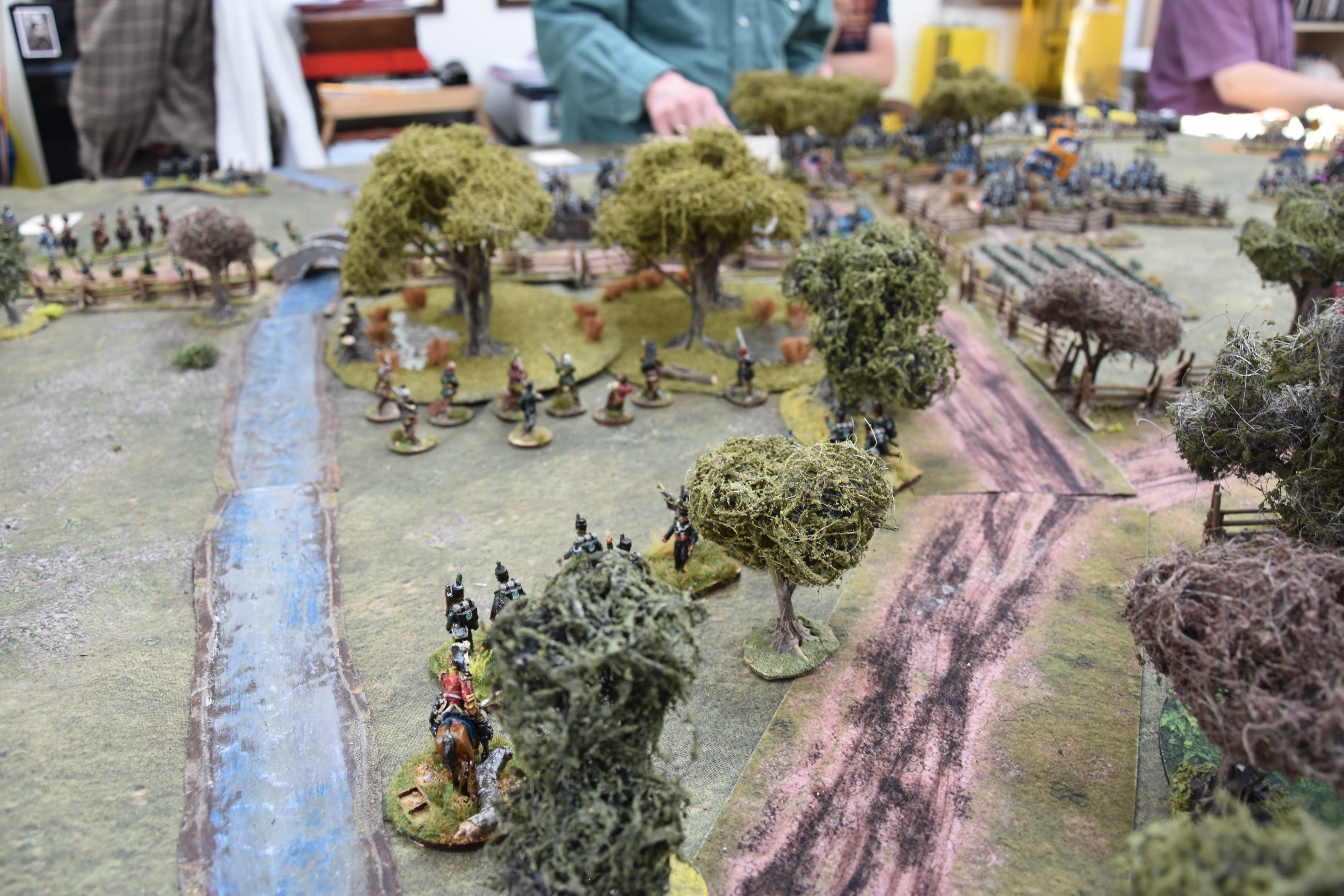
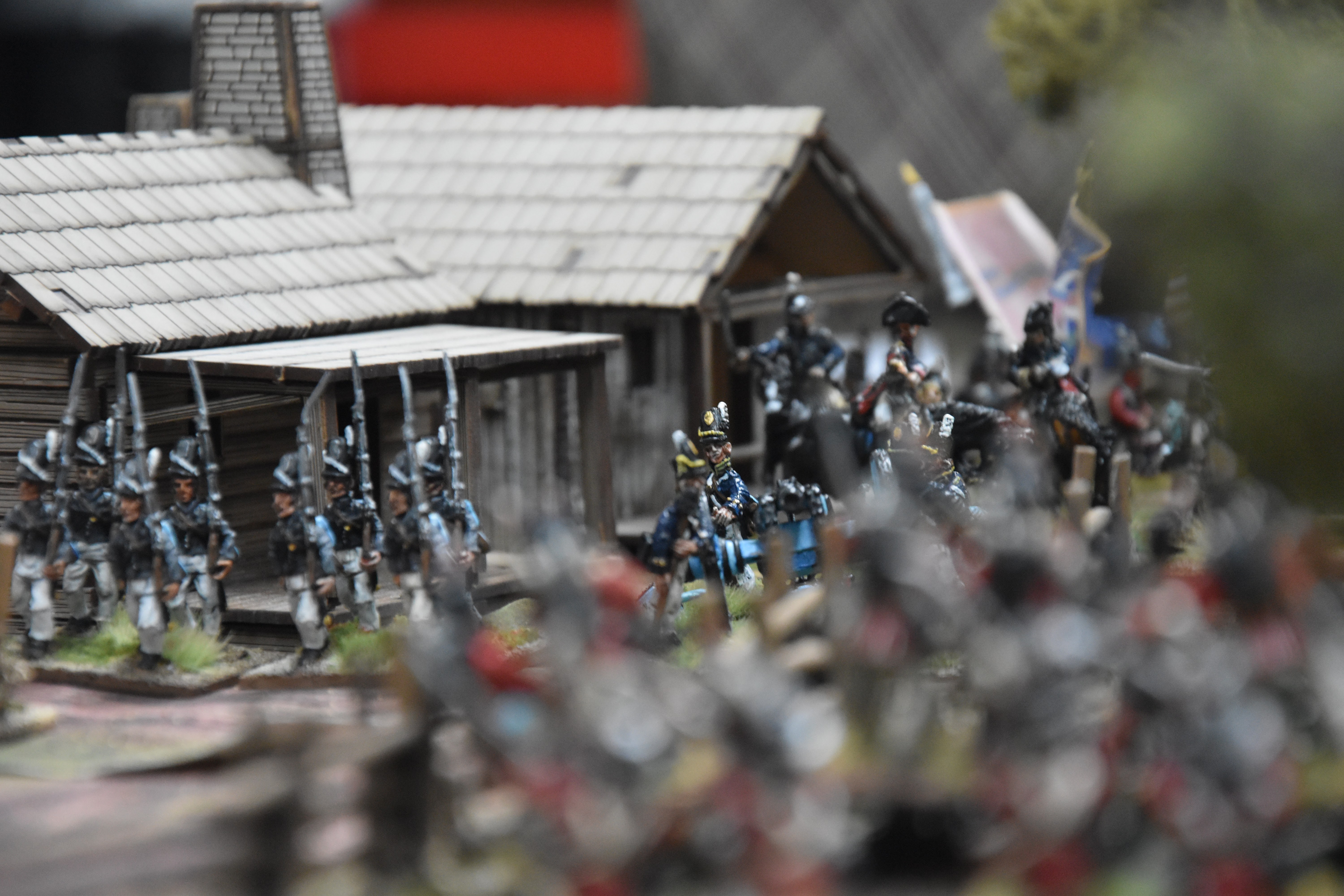
John and Mike were here yesterday for another game using Valour and Fortitude, this time set during the War of 1812. I had drawn up a pair of army sheets using the template that can be found on the Perry website so after a cup of coffee and a catch up we began. John took the Americans and Mike and I the British and Canadians. The game objectives were to control Monday’s Lane by holding the two road junctions, and to defeat the enemy and send them packing back from whence they came of course.
The British deployed first, with the advance guard brigade consisting of the Glengarry Light Infantry, detachments of the Canadian Voltigeurs, a troop of HM 19th Light Dragoons and a 5.5” howitzer, on the left flank. They were also accompanied by a band of First Nation warriors including a company of Caldwell’s Rangers. The three other brigades were thinly spread across the rest of the table ready to advance. John’s Americans arrived with the Kentucky ‘brigade’ on his right, Scott’s brigade of regulars to their left, then a brigade of militia and anther brigade of US regulars. On the American left were a troop of US Dragoons, detachments of US Riflemen and a composite troop of militia cavalry. The Americans outnumbered the British somewhat, but the latter were largely better troops (famous last words). The American commander was also classed as cautious which made it sleigh harder for his brigades to activate.
I was too involved in the game to take many photos or even take note of what was happening in as much detail as when I umpire so I hope the photographs and brief narrative are easy enough to follow.
 |
| The American right flank. |
 |
| The US militia brigade advance through the woods while a brigade of regulars head for the fence-lined lane. |
 |
| My First Nations advance towards the Kentucky troops. They are accompanied by a detachment of Caldwell’s Rangers and an officer of the Indian Department (in the red coat). |
 |
| Scott’s brigade advancing towards the road. |
 |
| Facing Scott’s brigade was my brigade, made up of a battalion each of Royal Marines and the West India Regiment, a battalion of Sedentary Militia and HM 1st Foot, supported by a section of Rockets manned by the Royal Marine Artillery. |
 |
| This is the second US regular brigade as they reached the lane.. |
 |
| The First Nations warriors charged the Kentuckians in the woods. |
 |
| My First Nations had charged the dismounted Kentucky riflemen in the woods but lost the melee and were routed, due to some unlucky dice rolling on my part of course! My light dragoons were also forced to retire after a brush with another unit of Kentucky Mounted Rifles. |
 |
| By Rockets Red Glare. They actually hit the enemy once and scared our side several times! |
 |
| Victorious Kentucky Mounted Rifles |
 |
In the centre HM 49th were routed after a deadly exchange of musketry with two US regular battalions and a section guns. This made a big hole in the line but we survived failing the Fortitude test.
|
 |
| Our right was making good progress in their advance on the Americans although HM 100th just over the bridge would break under the fire of the US Riflemen and an 18-pdr gun just visible on the road.. |
 |
| The composite troop of militia, including the Boston Hussars, the 7th New York in the front and two others I can’t remember at the moment. |
 |
My left hand brigade had to take a Fortitude test when the First Nations ran, and three shaken units also routed, including the Glengarry Light Infantry shown here. Only a lone detachment of Canadian Voltigeurs remained. Thankfully the Kentucky brigade refused to advance for the remainder of the game.
|
 |
| The centre brigades of both armies were crumbling under intense musket fire. |
 |
| Another British regular battalion takes to its heels. |
There are no more pictures sadly, but we decided that with two brigades almost annihilated, my remaining brigade pretty much all shaken, and a large hole in the centre of the line, the British conceded defeat and withdrew.
I have to say the rules worked well for this war. With troops capable of decent musketry and riflemen on both sides it was quite a ‘bloody’ affair, but it was also a decisive end to the game. The penny packets of artillery worked well, as they were not too deadly but they did whittle down their targets over time which was annoying and seemed about right. I’m warming to this set, but although they would undeniably work, I would still prefer something like General d’Armee for a big European-set game with multiple players.
It was overall a good way to spend a very wet Saturday. Next week it will be Rome vs Successors if all goes to plan.