Showing posts with label FRench Revolutionary Wars. Show all posts

Friday, 5 December 2025

The Armée des Princes book review.

 THIS IS AN ABSOLUTE CRACKER AND WILL UNDOUBTEDLY SHIFT MY FOCUS BACK TO THE FRENCH REVOLUTIONARY WARS.

    French Emigre Armies of the Revolutionary Wars Volume 1 : The Armee des Princes (1791-1792)

French Émigré Armies of the Revolutionary Wars, volume 1, by Hughes de Bazouges and Alastair Nichols is the 150th book in Helion’s ‘from Reason to Revolution 1721–1815’ series. From the moment you crack open this book, you can feel the authors’ enthusiasm leaping off the page. Rediscovering the French Émigré Armies.

The world of the French émigré forces, so often tucked away in the margins of history, finally gets its time in the spotlight. Instead of being mere footnotes, these units are front and centre, and the result is genuinely eye-opening and refreshingly different. The authors certainly succeed in opening up a hidden chapter of revolutionary history.

What really stands out is the sheer depth of detail. Whether it is the makeup of the regiments, the political intrigue swirling around them, or the nitty-gritty of their campaigns, it’s all here. Yet, the writing never feels heavy-going. Whether you are a seasoned historian, a wargamer or reenactor, or just someone with a passing interest, the story flows beautifully.

Let us talk about the visuals—maps, illustrations, and especially the uniform plates. These are not just pretty extras; they bring each of these short-lived, colourful yet lost regiments to life. With 24 pages packed with images each with an impressively detailed commentary, you can almost imagine yourself marching alongside the Armée des Princes.

The émigré armies were a colourful, dramatic bunch, and their story is rarely told with such care. This book fills a real gap, weaving together sources old and new to offer fresh perspectives.

In short, if you’re curious about the French Revolutionary Wars, counterrevolutionary movements, or the wild world of eighteenth-century European military culture, this is the book for you. It is both a joy to dip into and a solid reference you will want on your shelf. If this first volume is anything to go by, the rest of the series promises to be something special.


ISBN: 978-1-804515-38-9

269 pages

Paperback

Monday, 1 September 2025

Back to the Revolution, part 2

Continuing on from the skirmish on Thursday, Saturday saw the table re-orientated, terrain reset and more troops added. Those with losses from the earlier game started off carrying one or two hit markers depending on their losses. The Russian cavalry was too battered and useless and was sent off to escort the baggage as the army had been joined by a brigade of Austrian cavalry and another brigade of Russian infantry.

The French carried fewer losses over and received another brigade of cavalry and another strong brigade of infantry. The Polish Legion were also joined by their third battalion and two battalions of the Lombard Legion. The armies were numerically more or less balanced, except the French had four batteries of artillery against two of Russian mountain guns, and they had a slight advantage in squadrons and battalions, but not by much. Where the French were at an advantage was in their troops’ and generals’ quality, together with complete domination in the area of skirmishers.

What follows are the usual series of photos showing how the game progressed. John the Red, Nick and Shaun were the French while Neil, Nigel and Jon were the Russians.


The Polish Legion

The Lombard Legion


I've not annotated all the photos as I think they tell the story well enough. On the Russian right the French made very slow progress but did eventually drive the Cossacks out of the town. Their main line and the Russians barely fired a shot at each other, which given the poor quality of this French brigade may have been a blessing. (They were rated as newly raised with more enthusiasm than skill and experience).

On the right the Austrian cavalry got the better of the French horsemen but were unable to exploit their success. The French infantry on this flank advanced on the Russian positions. The Russians attempted several bayonet charges but to no avail and eventually only two of the six Russian units in the brigade were left, the rest having fled. While they could the Austrian cavalry survivors beat a hasty retreat.

In the centre the main attack was led by the Polish and Lombard Legions. They were facing four battalions of combined grenadiers (somewhat battered from their previous engagement but no less dangerous). The French were unable to break the Russian centre, even with their superiority in artillery and skirmishing capability.

The game had been set to last eight turns, by which time it was deemed the Russian baggage train had safely slipped away. The French had failed to prevent this so despite their success on the battlefield it was not enough to prevent the enemy escaping with a minor victory.

Valour and Fortitude are very much like marmite, with the added complication that some days I like marmite and others I don't.  I was less enamoured of them this time than I had been when playing the Paraguayan War.  But they work on big multi-player games like this and are imho infinitely preferable to Black Powder. Not everyone had used the rules but everyone was soon pretty much up to speed. With fewer players, and players who were familiar with the rules, I would probably have used General d'Armée II. 

Thanks to everyone for the game which hopefully was an enjoyable one. I now have the bug for another French Revolutionary Wars game next time. We shall see........

Sunday, 31 August 2025

Something we’ve not done for a very long time…..part 1

I’ve just been reviewing some of my troops this week and. It struck me that a game set during the French Revolutionary Wars, in Italy was long overdue. The Russian campaign in Italy and Switzerland was what kicked off my French Revolution collections (a small tightly contained campaign), and look where we are now with thousands of the buggers belonging to a wide variety of nationalities. 

The Russians only had these ex-Piedmontese mountain
guns by way of artillery.

Anyway this was to be a fictional but plausible encounter between the Russians and French in the foothills of the Italian Alps. Suvorov, having cleared Italy of the French, has been ordered to withdraw through Switzerland to join up with Korsakov’s army at Zurich. (We know how that ended). 

On Thursday John the Red came over and we played the opening stages of this battle, with the Russian covering force attempting to deal with the French advance guard which was hot on their heels. The outnumbered Russians had to hold for six moves by which time the rest of the army would appear. This would hopefully set the scene for the main battle on Saturday. 

We used Valour and Fortitude for both games, with some appropriately amended army sheets for the Revolutionary French and Russians as well as new sets of fate cards.

So here’s what transpired during our Thursday afternoon engagement. South is at the garden end of the table. The rivers and streams were only crossable for infantry at half speed. Nobody else could cross due to the steep and heavily ‘shrubbed’ banks. Apart from the walls everything else was just window dressing.

From the north, the French can be seen approaching in the distance. I have one Russian brigade on the left,  another, of grenadiers, on the right, supported by by puny cannon and a brigade of Russian cavalry (who should not have been there historically but I couldn’t find my Austrian cavalry. There were also lots of Cossacks well in advance of my brigade on the left.
My mountain guns didn’t fire a shot all game.
The Russian right advancing on the approaching French under heavy artillery fire.
The French left wing. Their right wing across the river was making terribly slow progress against the Cossacks.


French cavalry about to charge and defeat their Russian counterparts.

The best option to delay the French was to launch my grenadier battalions against their left wing, a move that was initially successful but ultimately a failure as all four grenadier battalions were driven back or routed.

The high point of the grenadiers’ assault.

Thankfully we had played the requisite number of turns and the Alpine night fell with a thump. Technically (and in reality) the Russians had taken a beating but had prevented the French from compromising their position and their soon-to-arrive reinforcements. The men of the match award went to the Cossacks who did a fine job slowing down the French advance on the right.  

Now to re-orientate the table through 90 degrees for part two on Saturday.


Thursday, 24 April 2025

Another Book Review - The Piedmontese Fight against Revolutionary France.

When I first saw this book on the horizon I was very excited at the prospect of reading it. The French Revolutionary Wars is a period that I find incredibly fascinating. Forty-Four Months in the Alps: The Resistance of the Piedmontese Army Against Revolutionary France, 1792–1796 by Enrico Ricchiardi is a well-researched and richly illustrated account of a lesser-known and often overlooked chapter in European military history. Set against the backdrop of the French Revolutionary Wars, the book delves into the challenges faced by the Piedmontese army as it resisted the expansionist ambitions of revolutionary France..


The book is nicely structured, firstly examining the political and military situation found within the Kingdom of Sardinia under Victor Amadeus III. The initial lack of preparedness was an issue, as were the intricacies of their alliance with Austria. The author moves on to examine the organisation of the army, drawing extensively from national archives to provide detailed information on a wide variety of units, uniforms, flags, and weaponry. Not only are the line troops covered in great detail, but also the militia, volunteers, the elite troops, and the navy.  


The author provides a very useful and detailed chronological account of the war between 1792 and 1796, guiding readers (and me) through the strategic and tactical developments of the Piedmontese army, their performance in the field and their final acts of resistance.


Ricchiardi's expertise is evident throughout the book. His background and deep understanding of the history of the Piedmontese army, particularly its uniforms and flags, lends authenticity to the detailed descriptions and illustrations. The inclusion of 29 full-colour pages of contemporary artwork and some lovely original illustrations by Emanuele Manfredi which collectively add significantly to the visual appeal.


Published by Helion & Company as number 144 of their From Reason to Revolution series, this volume is a valuable resource for historians, military enthusiasts, and anyone interested in the intricacies of eighteenth century European warfare. The author’s thorough research, combined with visual richness, makes it a standout contribution to the field. It is a fascinating period, a colourful army and an enjoyable and enlightening read. I certainly learnt a great deal about the campaign and the army and can highly recommend it.


ISBN: 978-1-804515-77-5   179 pages; Paperback

Sunday, 25 August 2024

Some more holiday reading; an eclectic selection continues……

The downside of spending chunks of time away from home is less opportunities for wargaming (that is pretty much none apart from a bit of painting and Zoom chats) but the flip side of that is that there is plenty of time away from distractions allowing me to catch up on my reading, and I have a lot of catching up to do.


This is the remarkable tale of one William Roworth of HM 44th Foot between 1786 and 1797. ‘Not So Easy, Lads.Wearing the Red Coat 1786-1797’ is the account of the service seen by this single English infantry regiment through the eyes of one of its other ranks in his letters home. Roworth rose to the rank of Serjeant Major by the time he left the army, after serving in the disastrous Flanders campaign before embarking for the West Indies, facing the horrors of a transatlantic crossing and the disease-ridden islands so vital for Britain’s economy. 

The author has used these personal letters together with a wide range of other original sources including official correspondence, private letters, army records and news archives to weave together a fascinating story of ordinary men on campaign. Roworth was a volunteer, as were many of his contemporaries, and served his regiment proudly despite the constant hardships and danger both on and especially off the battlefield. What lifts this book up above others covering the same campaigns is that we read here the perspective of ordinary soldiers, such as their fears, for themselves and their families, duty, ambition, and the sheer distance they were away from home. The author traces our subject’s service from his enlistment, home service, Flanders and the retreat through Germany, the horrors of the Atlantic crossing and the campaigns in the West Indies, ending with a look forward to the lives of those who survived. 

The book contains a great many black and white illustrations together with eight pages of colour plates, most of which are photographs of the islands where the battalion served as they are today, together with uniform plates and contemporary or near contemporary paintings. 

One of the most sobering things I took away from the book, despite knowing full well the effects of service in the West Indies, was that a muster return for troops on St. Lucia in November 1796 shows that well over half of the officers and men were sick in barracks or in hospital. Another return shows that between April and October 1796 almost 3,000 officers and men died of disease while as many as 4,000 to 5,000 were sick and unfit for duty at any one time. Sickness was no respecter of rank, and officers suffered the same as the men, as the data shows. Both Sir John Moore and Sir Ralph Abercrombie were struck down by fever but survived to take their places in history at a later date.

This is tremendous, candid and at times troubling account (from a 20th century perspective at least) and is a story of service and resilience that has been thoroughly researched and told well and should be read by anyone with an interest in the period, militarily as well as from a social point of view.  A really enjoyable experience; the book, not service in the West Indies in the late 18th century!

From Reason to Revolution 1721-1815.
ISBN: 978-1-915113-86-3 soft covers 285 pages


Saturday, 20 July 2024

A Couple More Helion Titles


Two for the price of one this time as I try to keep on top of my reviewing duties. Two very different books, but both worthy additions to Helion's Reason to Revolution series.

First up is British Regiments and the Men Who Led Them 1793-1815, volume 2, Foot Guards and 1st to 30th Regiments of Foot, by Steve Brown is the second of a planned series of five books which will go on to cover the remainder of the infantry (vols. 3–4) and Ordnance and other regiments (vol.5).


Again, you are presented with an encyclopaedic array of information relating to the lives and service history of well over1,000 officers commanding the regiments in scope for this volume. I want to repeat what I said when reviewing the first volume that it must not be forgotten that these men, for all their privilege, faults and foibles, and often wealth, gave their careers and lives in many cases, for their regiment and their country.

In a nutshell, if data is your ‘thing’ you will not be disappointed. Pretty much anything one might want to know about any particular individual is there;: dates of birth and death, parentage, education, career, awards and places of residence are brought together. As ever, the use of the purchase system to climb the promotion ladder by migrating between regiments (and arms of service) and the idiosyncrasies of the brevet system are also evident in these pen-pictures.

The author continues with the well-presented format used in volume 1 including, by regiment, service histories of each of the regiments of Foot Guards and the 1st to 30th regiments of the line. The author has consulted a vast array of primary, secondary and unpublished sources to produce this invaluable source book.

Is this book as good as the first volume? Absolutely yes as it 'does what it says on the tin'. Military historians, amateur and professional, war gamers and also from my perspective, with my other hobby head on, genealogists will find this publication of great value. I can recommend it unreservedly. A great source book.


ISBN:  978-1-804514-38-2 soft back 376 pages


The second offering is by Yves Martin and is absolutely wonderful. Citizens to Arms! Uniforms of the French Revolutionary Armies, 1792-1799 is a collection of glorious colour plates completed by French artist Henry Boisselier in 1943. Each of the 56 plates is accompanied by a comprehensive description of the uniform and the unit to which it belongs. 


We are introduced to Boisselier, his life and work and more. This is not just a book of admittedly very pretty colour plates. If it were, it would still be an amazing piece of source material for uniforms during the period. There is also an illuminating and charming chapter entitled ‘Forward, children of the fatherland!’ - True Tales of Volunteers. This is a series of accounts of a selection of these citizen soldiers, men and women, and their experiences during those tumultuous years at the start of the Revolution. Only one is remembered in history but the lives of the others are no less interesting. For me, the accounts of these humble soldiers' experiences and fates raise the book above that of just another uniform book.


For anyone like me who has a fascination, or obsession even, for the French Revolutionary Wars, then this book is highly recommended.


ISBN: 978-1-804515-42-6 soft back 150 pages


Thursday, 16 November 2023

Behind the Scenes: A visit to the Burrow from Wargames Soliders and Strategy.

This week I had a visit from Guy Bowers of Wargames, Soldiers and Strategy magazine. We’d spoken earlier this year when he asked about my French Revolutionary Wars collection, with a view to photographing it to support a forthcoming magazine theme of Napoleon in Italy in 1796. Now, my figures are not in the same league or even same planet as many that have appeared in magazines and continue to do so, but are (I would say) at least better than average wargames standard, whose only aim is to provide me and my mates something to use to game with. 

I can’t reproduce any of the pictures that Guy took until after the magazine has come out, but it was an interesting (and tiring) day setting up the table for Arcola and then Caldiero, moving the figures around, together with lots of generic shots. I’ve seen many of the pictures taken and they look pretty good so I look forward to seeing some of them them in print.

Thumbs up from the director, cameraman and lighting engineer all rolled into one. My main role was to ferry troops on and off the table, make bacon butties for lunch and hold up the backdrop (see later - I must get one).

Camera! Lights! Action!

Massed cavalry.

Austrian troops lining the river shooting at the French who had to march parallel up a raised roadway to reach the bridge at Arcola.

A ‘singles’ shot of a base of Frenchmen.

Massed cavalry again.

Imagine…..Me holding the sky up.

Back to normal now once I’ve done tidying up as John the Red is coming for a game on Saturday. I also have lots of reviews to finish and even more Russians and Swedes to complete. We are planning to be away in January and February next year so I need to squeeze in as many games and as much painting as I can in what remains of the year.

Friday, 8 September 2023

A Wargamer’s Guide to War of the First Coalition, 1792-1797

This arrived with a massive thump as it hit the doormat on Friday, and what a whopper it is; ‘A Wargamer’s Guide to the War of The First Coalition, 1792-1797’, by Garry Mills. This period is, as I am sure folks know, a subject very close to my heart and I was all a-flutter when I read through it last week.

What does the reader get for his money? In a words, LOTS! After the introduction there is a brief history of the French Revolution followed by a very comprehensive year-by-year and by theatre of war, outline of the war which takes up a third of the entire book. There is a useful chapter covering each nation involved in the war, big players and small, including France, Great Britain, Piedmont, Austria, Prussia, Spain, the United Provinces, Naples and Emigre and other Royalist forces. These sections include a description of each nation’s armed forces, organisational details and more. 
There is even a piece on naval forces employed in the war.

Given that this is a wargaming guide, it is no surprise that  the following chapters cover ‘Wargaming the Period’ and ‘Building the Forces’.  These are thoughtfully presented and will be a big help to anyone new to the period. Also in this section is a how to painting guide.

The next chapter includes 10 ready-made scenarios, including three dedicated to naval battles. The land-based scenarios are full of detail, representing a variety of protagonists and size of engagement, and come with maps, orders of battle, troop qualities and so forth, starting with Lincelles and ending with Castiglione.

The book concludes with sections signposting readers to suppliers of miniatures and terrain and online resources available, together with an extensive bibliography.

As well as the maps there are a number of contemporary illustrations both in colour and black and white, and photographs of troops in action on the tabletop. I am pleased to say that all the photos of 28mm games included in the book are of my own ever-growing collection of miniatures.

From my point of view there is nothing not to like about this book and within the parameters put down by the author he has achieved an impressive feat, and this is not only the best in the Helion Wargames series but also a very good one-stop-shop for gamers, whether already deeply involved in the period or considering it as a new project. I can absolutely recommend this excellent piece of work, especially if it draws more people into wargaming the French Revolution. 

ISBN 978-1-805412-03-6  soft back, A4, 301 pages.

Monday, 26 June 2023

Eagles over the Alps

Readers of this blog will be aware that this campaign is one that I was drawn to many years ago, and I now have rather a large/enormous collection in 28mm. Of all the late Christopher Duffey’s many books this is by far my favourite. Helion are steadily going through Dr Duffy’s back catalogue and offering reprints back into the market. Given that many of his books now attract prices in the hundreds of pounds sterling this is a great move by Helion as it brings many of his masterpieces to the notice of a new generation of military historians, history buffs and wargamers at an affordable price.

Helion’s edition of Eagles over the Alps. Suvorov in Italy and Switzerland, 1799 has been available for six months or so but its appearance might have passed some potential readers by. For me this is the go-to English language book on the subject and remains in my humble opinion the most readable and interesting account of a pretty miraculous campaign, under the command of the veteran, talented and legendary Alexander Suvorov.

The book begins with a discussion on Suvorov and the composition and structure of the Russian army he commanded, the long march to Italy and the campaign against the French, who were defeated time and again and almost driven from Italy completely. An invasion of France from the south was suggested by Suvorov but the idea failed to win favour with the Czar and his council, so the long withdrawal through Switzerland to meet up with another Russian army on the Upper Rhine began. The story of the almost constant rearguard actions and attacks is told in great detail, all supported by many excellent maps and photographs of the actual ground being fought over. Suvorov led his men to safety, maintaining discipline throughout, despite the dreadful weather, the treacherous terrain, severe losses of men and material, and several French forces determined to cut off his retreat and destroy his army.

This is a well written and researched account of what was a relatively minor episode when taken within the context of the greater Revolutionary and Napoleonic Wars but it is presented as a great adventure against the odds in much detail. Anyone interested in the French Revolutionary Wars should find this book invaluable in understanding the campaign, be they military history buffs, wargamers or both. Highly recommended.


Saturday, 10 June 2023

Counter-Revolution in the Vendee 1793

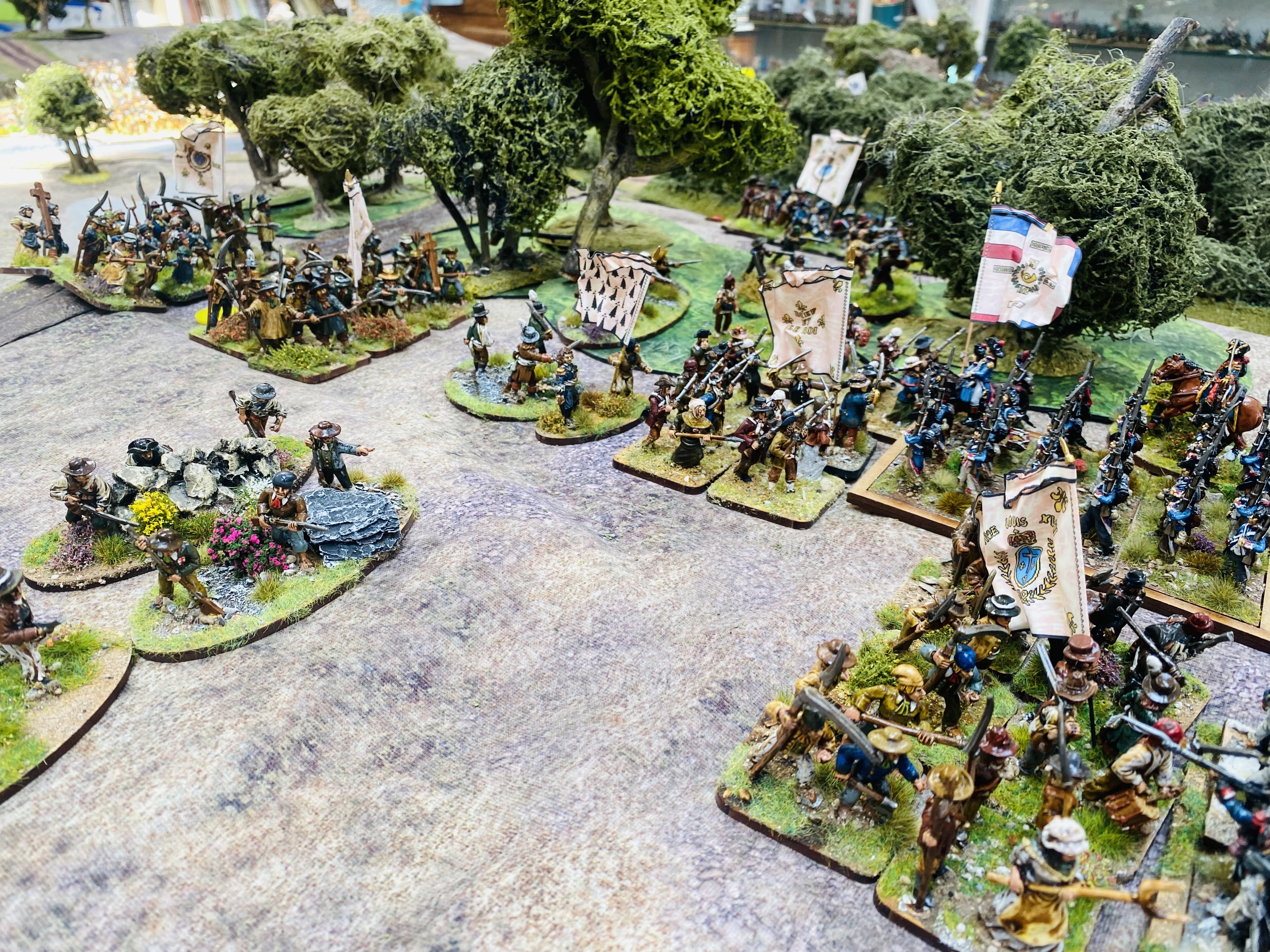
I’ve never had all my Armee Catholique et Royale on the table; indeed I had lost track of just how many miniatures I have, the answer being I have lots! I had to base up about a third of the Vendeans yesterday (Thursday) and they still require tufting but I did did get their bases budgie gritted and static grassed by the time we started the game on Friday morning.

John and I had arranged to play a game on Friday and as Conrad was free he joined us, taking command of the Vendean troops. John was the opposition. I decided not to play and oversee events to throw any suitable spanner’s into the works. This was a bit of an experiment as I wasn’t sure exactly about how to classify the Vendeans. In the end I opted for really good skirmishers, fairly good close order masses with some limited firepower, or less good units of second class close order troops, saving on 5+, and finally the ‘mob’ of even more ill equipped and fragile infantry with no firepower and saves on a 6 only. 

Anyhow, the Republican army had to drive the enemy before them down the length of the table and capture the farm, inside of which were several high ranking Vendean commanders, sacks of English gold and other goodies best taken into ‘care’ by the Republic. All the Royalists had to do was stop them. The Republicans had a strong  advance guard of decent infantry supported by cavalry and horse artillery. The main body had mainly decent infantry (its all relative) with some dodgy volunteer battalions, whereas the reserve was made up of newly raised levee en masse. We used Black Powder with my house rules.

Here are some photos which should show how the battle played out. A note on terrain. The hedges were classed as very thick so any formed unit crossing had to throw 1D6 for disorder. The better the troops the less chance of becoming disordered, but even they had to avoid a 5 or 6 when crossing. I think the game proved to,be a challenge to both sides, due to the paucity of commanders in the Vendean army and the very mixed quality of the Republican troops and density of the terrain. I was quite correct in these assumptions!

The vanguard of the Republican forces marching down the road. Cavalry and horse artillery have pushed round the church.

The Vendean first line of defence.

….and their second line.

More Vendeans in reserve.

In the centre Vendean skirmishers lurking behind the hedgerows.

The head of the Republican ‘column infernale’.

Conrad moved his main body up to the river.

More Republicans enter down the other road, a mixed brigade of  veteran line infantry and volunteers of 1792, with a battery of 8-pers in support.

Royalist skirmishers in action. They didn’t cause many casualties but kept several of John’s units in a state of almost permanent disorder.

A mass of peasantry ready to defend their land.

Republicans attack the Vendean right.

John failed to do much damage to the enemy when they did close to hand to hand combat.

On the other flank John’s men were hampered by repeatedly becoming disordered as they cross the bocage-like hedgerows. The 8-pdr battery barely managed to open fire all day as it was masked for much of the time by disordered friendlies reforming to their front.

Meanwhile more Vendeans cross the river.

The Republican horse artillery proved particularly ineffective. A probably misguided charge by their supporting cavalry was thrown back.

The attack on the Republican right was building up momentum.

While on the other flank the Vendeans managed to hold and cause the brigade attacking them to become broken, which was a blow for the Republican plans.


Johns troops had better luck on the other flank, driving the enemy back over the river and out of the woods.

Conrad’s reserve of several mobs of peasants launched an attack on the French-held woods.

The peasant mobs were forced back after a fierce fight.

John didn’t want to bring his reserve on the table as it was made up of very poor troops (newly raised levee en masse) and thought it was unlikely to make much difference to the outcome. I don’t believe that to be true as no matter how bad, they could provide useful support to the remaining veteran battalions. We will never know. 

Both sides had one broken brigade, but with the absence of his reserves John was unlikely to be able to achieve his object of reaching the farm, so a minor victory for the Royalist reactionaries was declared. I need to make some changes to the troop stats if I use BP2 again for this conflict, but I’m intrigued to see how General d’Armee would work in a similar scenario. Next time perhaps. 

I rather enjoyed the game, as did the others, and it was very nice to see my entire Vendee army on the table. Most of the Vendean figures are the lovely Trent minis now only available from Skytrex/Warlord at inflated prices, or the equally nice Revolutionary Wars range by Emperor Toad. Other manufacturers in the mix include  Foundry and Westwind (vampire wars peasants).