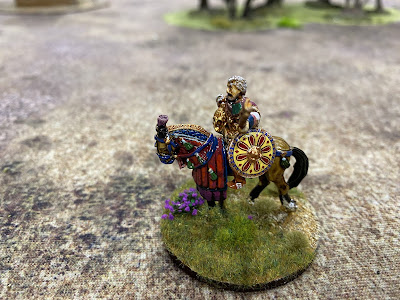
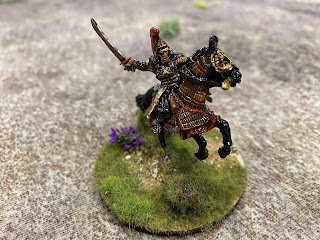
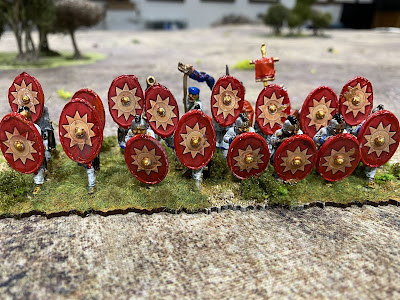
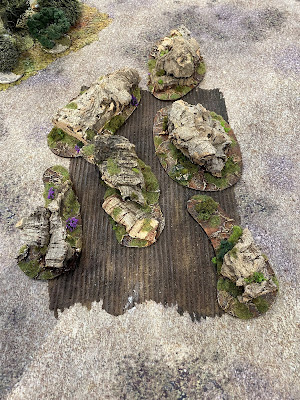
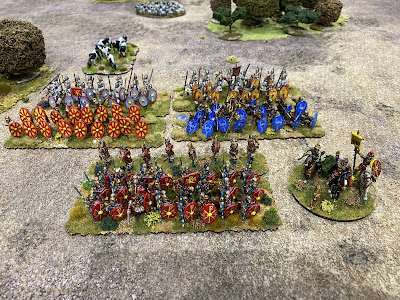
The next battle in the campaign actually takes place at the same time as the one last reported on Here. This time the armies are both Roman. The army of the false (?) emperor Digito the Apostate (not only was the false emperor advocating a return to the Republic, but he was also in favour of ditching Christianity and going back to the old gods!) has been ambushed by the Comes of Asienus Inferior, Paulinus Gormanicus not far from the town of Maluscastra, which has just thrown in its lot with him in his campaign against Digito. Paulinus was outnumbered by around 20 percent but as the ambusher had certain advantages, in theory at least!
Neil and Nigel on the right in command of the absent Paulinus’ army.
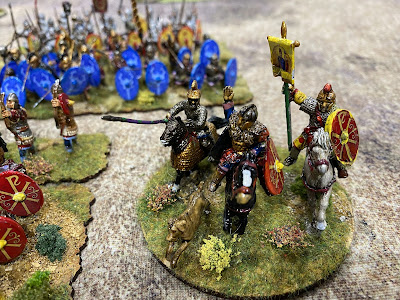
Digito in his chariot, looking very ‘imperial’.
Digito was leading his army in person (Richard) but illness and house damage from Storm Arwen forced Paul to withdraw, leaving his army under the command of Neil and Nigel. Of course, for the campaign narrative Paulinus will be reported as nipping back to Maluscastra for a minute to “bring up reserves”.Yeah!? Pull the other one.


Richard was aware of the presence of Paul and his army but had to bring his own army onto the table in three columns, one on the road and the others either side. As a precaution he also had a flanking force due to arrive at some point on the enemy left. Paul’s army was deployed in ambush positions on both flanks and ahead of Richard’s columns. I’d asked each of them for five ‘magic’ numbers. I paired them off against each in the order they were given to me and Paul’s selection beat Richard’s until the last pairing, so Paul’s ambush was sprung when Richard’s army was within one move of him, or thereabouts, terrain permitting. If Richard’s numbers had beaten Paul’s earlier in the pairings he would have spotted the ambushers sooner. It made sense to me so I hope it does to everyone reading this. For those interested in this sort of thing, we used the excellent Sword and Spear rules and the army lists as a guide. Paulinus had chosen to use the standard Late Roman list, but Digito had gone for the Foederati Roman list. He also had some Goth mercenaries, hired off the Ostrogoth player in Turn 1 of the campaign.
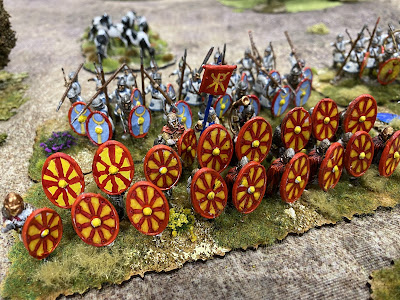
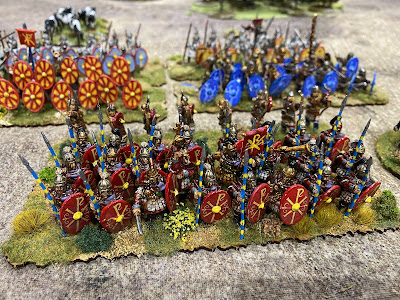
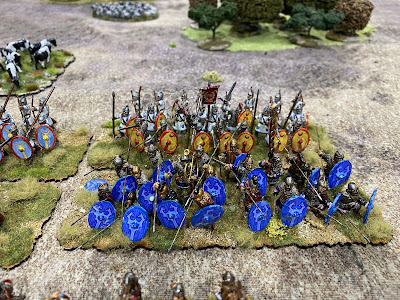
So here are the photos of the game, which are I hope self explanatory.
As the photos might suggest, it was a very confusing battle to recall all the detail for this post, let lone under sweat was going on during the game. I commanded Richard’s right wing which was made up of all his cavalry, and had no idea what was happening in the centre, let alone the other flank.
My command was all cavalry so faced some difficult opposition from the enemy legions but at least we pinned them in anticipation of the flank attack, if and when it arrived. My troops and those facing them took heavy casualties and a number of units were broken before the flanking force arrived. The close terrain didn’t do us any favours and it was difficult to get into contact with the enemy, but eventually, despite loosing all our Goth mercenary cavalry and the death of the flanking force’s commander the enemy wing was defeated.
Over on the other flank our troops were holding their own but were unable to make any lasting impression on the enemy, there were just too many of them. Nigel’s Captain fell at the head of his men as they slowly ground down our left wing. By the end of the battle our left, or what little remained of it, was in full retreat. Our centre fared little better as our Foederati warriors failed to make contact with Neil’s troops in sufficient quantity and were dealt with as they were only able to launch their attacks in a piecemeal fashion.
Richard was plagued by a succession of dreadful combat dice rolls throughout the game, so even though we won the initiative on every turn until after lunchtime, it did us no good as the plan went pear shaped from turn one and stayed that way until the end of the game maybe a dozen turns later.
With my campaign umpire’s head on I declared Paulinus’ army the victors. Richard would be able to pull back unopposed as we still had lots of cavalry to cover the retreat. Perhaps 40 percent of his army lay dead on the battlefield, but Paul’s army had also suffered heavily, to the tune of around 30 percent losses. Paulinus’ prestige increased following his victory, despite his absence, while Digito’s dreams of conquering the province have been squashed for the time being at least.
Next time in the west of the province the army of General Titarse Jarminicus faces the Huns, after which the vengeful Ostrogoths descend upon the army of Johannes Rubrum as he falls back after sacking the Ostrogoth capital against the orders of Digito.