Tuesday, 14 June 2022

War of 1812 playtest of 'Soldiers of Napoleon'


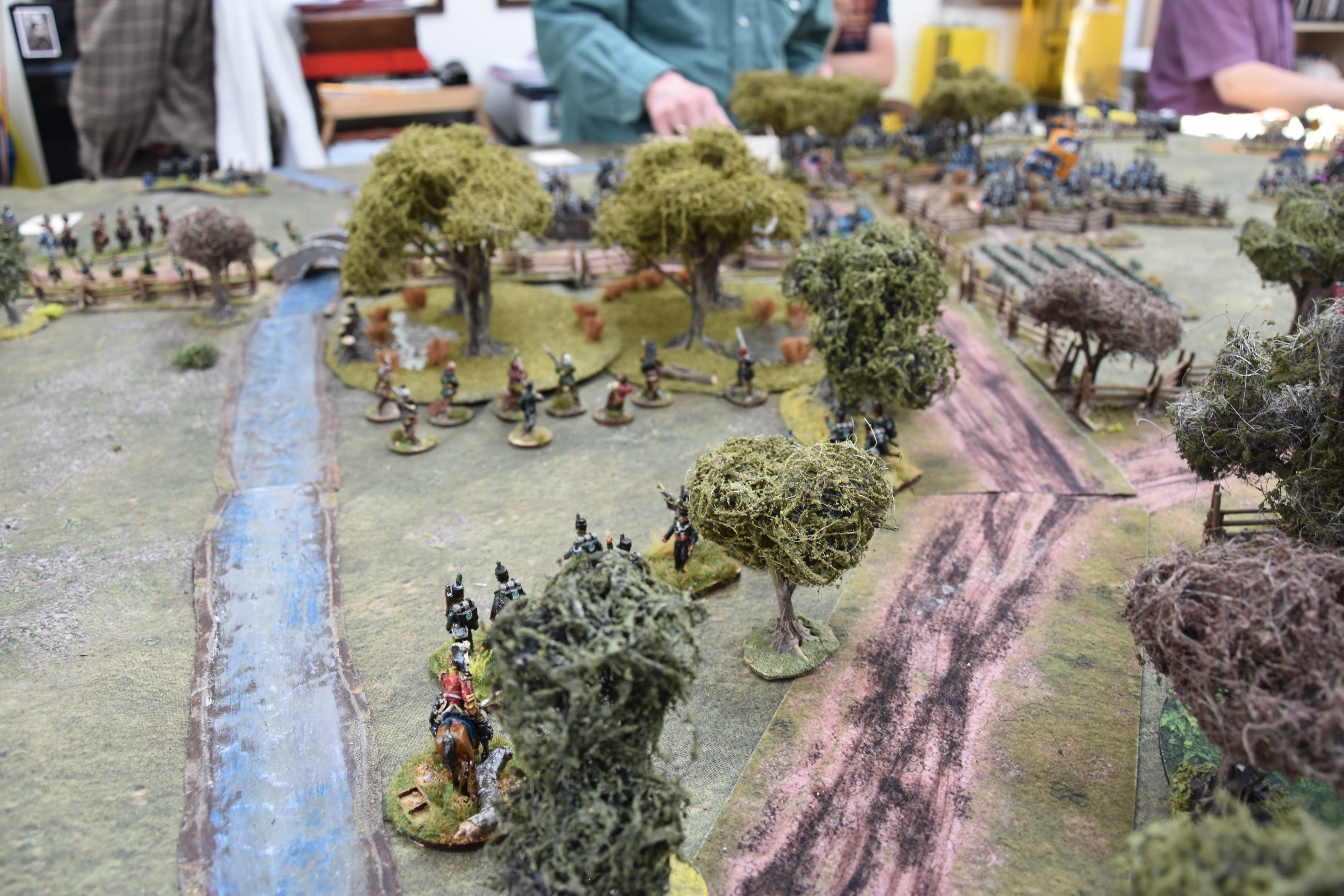
British/Canadians on the left, Americans on the right.

OK, so no sign of Napoleon or his soldiers on the table but I saw these rules at Partizan and thought they looked promising, or different.  I don't need another seat of Napoleonic rules as I'm confused enough as it is with those I already play, but, I thought, these are card driven, which is always fun (for the umpire at least hahahaha!).

De Mueron's Regt on the British right.

Something smallish (what? will never happen!) was called for so rather than using my French Revolutionary Wars armies (sans Napoleon of course) I opted for the War of 1812 collection. It didn't take long to classify most of the different troop types in line with SoN, although some such as Native Americans and the various skirmish types and the mounted riflemen were tricky. As it was a multi-player game each of the players would command a single brigade (as it turned out a couple had two brigades). 

I had an embryonic 1812 collection for a few years but have been seriously collecting and gaming the War of 1812 ever since Covid lockdown #1 and find it a fascinating conflict, so I was keen to see if SoN gave me something that Black Powder didn't. (I like BP and Gen D’Armee but as I'm a rules butterfly I'm too often prone to pick up others to try out).  

It was a fictional encounter battle somewhere around the Lake Erie with the Americans trying once again to conduct a special operation and liberate the oppressed Canadians from their despotic British rulers.

Richard, Shaun and Nigel were the Anglo Canadians while John, Neil and Conrad were the American invaders. Apart from throwing back the Yankees the vital (?) bridges and road junctions were nominated as objectives. To accommodate the rule about off table artillery fire I said that there was a fort and a gunboat on the lake that would do the job if the card was played. The photos are a mixture of mine and Richard’s and have become hopelessly mixed up and out of order so apologies if this is confusing. [you should have been there to see what real confusion looked like during the game]. I've not captioned all the photos as they speak for themselves really.

The British unlimber a gun to cover the bridge and main road.

In their centre the British set up their Royal Marine  rocket section which  despite a tremendous display of pyrotechnics failed to hit anything the whole game.


The British centre.

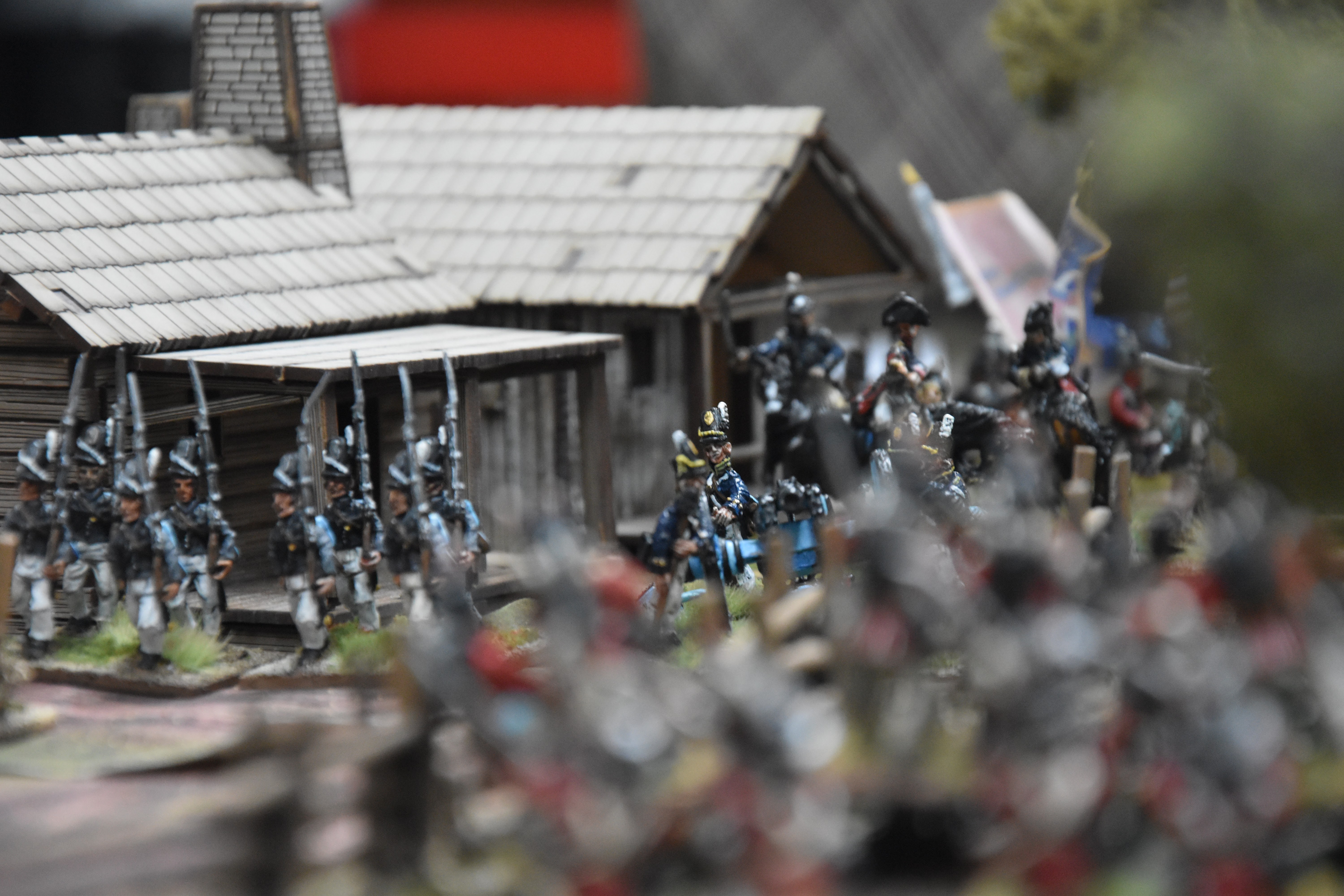
The US troops quickly occupied the farmstead in the centre.

Glengarry LI advancing.


Suffice to say it turned into a bit of a bloodbath. The British pushed through the American centre, driving back or destroying several regiments of US  regulars, but loosing heavily in the process. There was little action on the British left and on the right they stormed the farm occupied by Neil's troops, but although driving the garrison off were repulsed. When I tallied up the VP's the Americans had a clear advantage so that and the tabletop objectives resulted in a small victory for their forces.

How were the rules? The mechanics worked fine and I shall happily play them again (in a European context perhaps) but despite the card driven nature of the game (which I really like) the jury is out until then. My only observations were an absence of ranges on the QRS (minor), the short movement distances for infantry, and doubts as to whether the rules can be readily and easily adapted for the big multi-player games that I run here at the Burrow. I accept that they're aimed at the later Napoleonic period (which does actually cover the War of 1812) and  I suspect one-on-one games on a 6' x 4' table rather than my monstrosity which meant that the two main battle lines took several turns to get into range of each other.  Overall, 7/10 for now. 

Friday, 3 June 2022

Fall of France 1940 using Iron Cross

Last Saturday (which seems a long time ago) it was the Fall of France here in the Burrow, or at least a small 1/72 representation of a small part of it. Equal points (1,000 each) of Germans v a Franco-BEF force in an encounter battle fought over a crossroads and three railway bridges.

My friends Tim, Barry and James from the Like a Stonewall Group came up for the game; indeed Tim brought all the figures and some terrain as well. John joined us for this brutal little game. I was the French, James the BEF and between us we made a great job of helping France fall, and the others were the Germans. Tim sort of umpires but also took some Germans to push about the table. The figures, buildings and railway line were Tim’s and the rest was mine. Almost all the vehicles and buildings were 3D prints produced by one of the LaSW lads.

I was so engrossed in the game I both neglected to take many photos and lost track of events as the pressure on the Allies mounted. So, in time honoured fashion here are some photos of the heroic defence attempt by the Allies against the Bosch onslaught. 

The calm before the storm.
Both sides arrive on the table. Cat takes up residence in the bushes!

The French started on the table. I began feeding my tanks around the wood to cover my men attacking the crossroads.

The Bosche heavy hitter arrives.

I managed to destroy a PzI early in the game.

My main arrack was aimed at taking the wooded area and then move on to the village. Infantry first supported by my armour.

The BEF arrive.

My contribution was these two die cast Somua tanks. They were both destroyed in fairly short order by some good shooting from the German right.

This Char B staying the bridge the whole game and at one point was one hit away from destruction when I had the chance to rally some points off. I scored a 6 so ALL the damage points on this beast were removed. Phew! Zut Alors!


The BEF just stood on the baseline and blasted the  Germans, taking heavy losses in the meantime.


The crossroads. The Bosche beat me to it and the ruin to the right of the church was the graveyard of three of my infantry sections! 


The French and BEF were giving the enemy a good hammering but my troops had been pretty much annihilated. What remained withdrew, covered by the BEF.

It was an enjoyable game and the rules (Iron Cross) worked well especially with the LaSW house rules and extra home made tactical cards. Thanks to Tim, Barry and James for coming up from Mansfield and to John the Red. 

I hope to have a game on Saturday next, ie 11 June. Not sure what yet……?

The Soldiers are Dressed in Red - the Quiberon Expedition of 1795 and the Counter-Revolution in Brittany.


The Soldiers are all Dressed in Red. The Quiberon Expedition of 1795 and the Counter-Revolution in Brittany’ by Alistair Nichols is the latest in Helion & Co’s continually excellent and rapidly expanding From Reason to Revolution series, No. 91 in fact! I have been fascinated by the French Revolutionary Wars and the War of the First Coalition in particular for many years so I was almost chomping at the bit waiting for it’s publication! I was not to be disappointed.

This book provides the reader with a long-overdue English-language account of the doomed expedition, the express aim being to support the chouan uprising in Brittany but also to attempt to topple the French republican regime. The author has drawn on memoirs, archival material and other historical works and he seeks to provide a comprehensive account of what was in reality a joint expedition between the French émigrés and the British Government and place it in the context of wider events. In short, this book does what it sets out to do very well and in a very thorough and readable way.

The narrative takes us through every phase of this doomed expedition, from concept, planning, embarkation, disembarkation at Quiberon, the reaction of the Republican forces and then the series of bloody combats as the emigres vainly tried to hold their positions, followed by the capitulation, escape for many and for the majority, retribution. The accounts of the various engagements are very clear and I found it easy to follow events as they unfolded. The use of original documentation allows for some quite detailed analysis of how the expedition was faring,. One aspect that is with hindsight rather saddening are the capabilities ( or lack of) of the emigre commanders and their men, many of whom were fated to face a firing squad or worse. I said it was a doomed expedition from the start and the more I got into the book the more I understood the futility of the invasion and the hopeless situation of the troops once they were landed. I was also reminded that some of the emigre regiments (Royal Emigrants and the Uhlans Britainiques for example) were veterans of the campaigns in Flanders and the Low Countries so were no pushover in the final reckoning.

The book contains a number of black and white photographs of the Quiberon area as it is today as well as a range of particularly helpful maps of the region and of some of the actions that were fought after the landings. The eight central pages are as is usually the case taken up with some lovely colour plates. One of these, spreads over two pages, is an original work commissioned for the book and painted by Giorgio Albertini, depicting the aftermath of the attack on the Sainte-Barbe lines, which is stunning. The other plates are of a wide range of colourful Émigrée and no less colourful Republican uniforms printed courtesy of the Anne S. K. Brown Military Collection.

The book ends with three appendices covering the landings, the French Republican order of battle and some notes on uniforms. The Republican orders of battle are of particular interest to me as its not something I’ve seen before whereas the ´Emigré order of battle is quite well known already. Also, throughout the book are full details of the not inconsiderable number of British troops embarked but not committed to the invasion, (a possible ‘what if’ scenario perhaps) and the warships and transports used.

A fascinating and well written book, quite an easy read and one I can happily recommend