I am really excited about these. Dangerous as I might be tempted to do some more Republican French.....

I am really excited about these. Dangerous as I might be tempted to do some more Republican French.....
I haven’t done any book reviews for a little while so here are three all at once. Each is a new or revised edition of volumes published by Helion a dozen or so years ago focussing on the opening moves of the France-Prussian War. They are of course wonderful.

The Campaign in Alsace August 1870 by Brigadier-General J.P. Du Cane CB is a new edition of the book originally published by Helion in 2010. It is number 56 in their excellent ‘from Musket to Maxim’ series. It provides an account of the early phases of the Franco-Prussian War, specifically examining French and German military actions in the Alsace region and the battles of Weissenburg and Wörth. First published in the late nineteenth century, it combines historical analysis with military commentary and reflects the author's experience as a British officer observing European warfare during this period.
The focus is primarily on high-level operations and command decisions, with less attention paid to the experiences of rank-and-file soldiers or broader socio-political context. Du Cane examines troop movements, command decisions, and battlefield outcomes using a methodical approach. The analysis is presented in a factual, restrained manner without emotional or nationalistic language. This approach provides credibility when comparing French and German military operations. The author reviews the structure of the French command, noting challenges with cohesion and preparedness, and describes the strategic discipline and operational efficiency exhibited by the Prussian forces.
A notable strength of the book is its inclusion of seven clearly drawn maps and tactical sketches, which I found helpful in visualising complex manoeuvres, particularly those related to the battles of Weissenburg and Wörth. These features contributed to my understanding of the ways in which terrain and timing affected the outcomes. There are four appendices which give detailed orders of battle for Weissenburg and Wörth.
Overall, The Campaign in Alsace August 1870 remains a valuable resource for students of military history, especially those like me who are interested in the Franco-German War, nineteenth century warfare, and the evolution of operational doctrines. While not a narrative history in the modern sense, it offers a disciplined, insider’s look at a pivotal campaign through the eyes of a contemporary military observer.
ISBN: 978-1-804518-82-3 101 pages, paperback
The Battle of Spichern is a new edition of the original book Helion published in 2009. It is more than a retelling of a nineteenth century clash but more of a tactical masterclass. Written by G.F.R. Henderson in 1891, who was a British Army officer and respected military thinker, this book breaks down the August 1870 battle between French and Prussian forces with great precision and dramatic clarity.
Through detailed maps, tactical sketches of the battlefields drawn from ground level, eyewitness reports, and detailed analysis of each stage of the battle, Henderson explains how leadership, terrain, weaponry, and sheer human will, contributed towards the ultimate the outcome. What unfolds is a timeless study in battlefield decision making, command under pressure, and the real consequences of tactical error. Despite its age and writing style I found the narrative completely enthralling and despite knowing the ending it was a difficult book to put down.
In addition to aforementioned maps and so forth there are a large number of contemporary black and white illustrations and a complete order of battle for both the French and Prussian armes and a breakdown average strengths and of losses suffered. One fact I found especially interesting was that in terms of number actually engaged, the figures are pretty much even.
Whether you're a military history enthusiast, student of leadership, or just love a gripping true story, The Battle of Spicheren remains essential reading. I found it clear, compelling, and surprisingly relevant more than 130 years after it was written.
ISBN: 978-1-804518-50-2 273 pages, paperback

Originally published in 1891, The Battle of Wörth by George F.R. Henderson represents a significant contribution to classic military history literature. The work provides a concise yet comprehensive analysis of one of the earliest major engagements of the Franco-Prussian War, detailing the conflict between Marshal MacMahon’s French troops and the German forces led by Crown Prince Frederick. This revised edition, first issued by Helion in 2013, incorporates a curated collection of pertinent images and an extensive bibliography related to the Battle of Worth. Additionally, it features a new foreword by Helion owner Duncan Rodgers.
Henderson, a British Army officer and one of the most respected military historians of his day, wrote this primarily for fellow professionals — and it shows. If you enjoy studying how nineteenth century armies were armed, organised, moved, fought, and failed, you’ll find it deeply rewarding. Certainly the depth of research and the detailed analysis of every moment of the battle makes for a gripping read as we get a blow-by-blow account of the battle.
There are 22 contemporary black and white illustrations and photographic portraits of some of the key players on both sides. The images of troops in action are excellent, being full of movement. There are five excellent maps and two detailed panoramic sketches of the battlefield, one each from the French and German perspectives.
The book also boasts seven appendices. As well as the extensive orders of battle, there are others covering the losses incurred by both armies; some French regiments suffered between 77 and 93 percent losses and were effectively annihilated. Indeed a staggering 50 percent of the infantry and 32 percent of the cavalry were casualties on the day, which totalled around 8,000 killed and wounded and 6,000 unwounded prisoners. German losses were numerically slightly higher but as a percentage just 11 percent of those engaged. German artillery expenditure (nearly 10,000) is also included, together with a breakdown by target type of the effective range of German artillery. We then have extracts from regimental histories which give an insight into infantry fighting at regimental and lower levels. Finally, Duncan has compiled a comprehensive guide for further reading which is an extensive, massively diverse, list of reference material. Some of it is general ‘stuff’ (official or general histories of the war) but also included are a significant number of French and German regimental histories, usefully grouped together by corps or division.
There is very little on the politics, civilian experience, or larger context of the war; rather the focus is wholly on what it should be – the battle. This is a soldier writing for soldiers, and the style could be considered dry and dated by today’s standards, it being written in 1899. I cannot say I found this to be the case. Henderson’s clarity of thought and respect for both French and German command make it a most worthwhile read for any serious student of military history. I am fascinated with the Franco-Prussian War and have no problem in recommending this book to like-minded souls. If you missed Helion’s first release then it is well worth buying now.
ISBN: 978-1-804517-90-1 119 pages, paperback


This volume follows the same tried and tested format as the previous three volumes, and is profusely illustrated with 58 images, many of the battlefields, both then, and as they can be seen today, some of the latter annotated with key points of interest from the actual battle. There are also a number of more somber photographs of graves and monuments to the fallen. This tremendous range of illustrations are accompanied by strategic and tactical maps which together with the narrative combine to present a free flowing and detailed account of events.
The book begins at the end so to speak, with an account of the surrender of Sedan, much of which are the letters and reminiscences of those present in the proceedings. The following chapters each focus on one significant event, that is the fall of Strasbourg, Metz and the battle of Servigney, and the siege and fall of Metz. We then delve into the immediate aftermath of 'La Debacle' , the questions asked of how could this have happened, the recriminations and the bold decision by the new republic to continue the war. Every chapter contains a vast a mount of first-hand experience and contemporary documentation; as always I find the private correspondence especially interesting as a direct window into the thoughts of those caught up in the war.
The final two chapters provide some excellent reading for those wishing to wargame the conflict, as each covers, in some depth, the tactics of both the French and the Germans. I think these will attract a great deal of attention.
As ever, there are numerous appendices (31 in all), providing a vast array of detailed information on subjects such as orders of battle, casualty returns and after action losses. The bulk of the appendices include capitulation treaties and correspondence and reports on subjects as diverse as the destruction of the French eagles to German siege operations. The best appendices for me are the last four as they examine the effectiveness of French artillery, the Mitrailleuse and a comparison between the French and German weapons.
This is a fitting final volume in what has been for me an absolutely wonderful series. I am now hoping that the author will not rest on his laurels but will now examine the Republican phase of the war in as much detail. Please.....
ISBN 978-1-804514-59-7 softback, 546 pages


 |
| I’ve had these on the desk for maybe a year or more. I now have three and a half brigades of Austrians; 21 battalions of line and four of jager, together with their artillery, making a full corps, or they will when I finish the last three infantry battalions sitting in the lead mountain. |
 |
| My Prussian jäger battalion is based in close order so when I saw these then unpainted figures going for pennies (it’s relative to their price new) on eBay I needed no encouragement to buy them. |

A couple of random items were finished today. I seem to have quite a few odd and ends for the War of 1866 and the Franco-Prussian War littering the painting desk so more may well emerge over the next few weeks.
 |
| First up is a little FPW scene with a French officer politely asking two Prussian officers the way to the POW camp. The Prussians are Perrys and the Frenchman is actually from Tiger miniatures’ Balkan Wars range. |
 |
| Another unit to add to my Prussian 2nd Reserve Corps for the Campaign on the River Main in 1866. These are the Hamburg Dragoons. Of course they never saw any action to my knowledge but are quite resplendent in their green uniforms. These are old Foundry figures painted for me by mate Barry. I just based them and found a suitable flag. |
Like my other odd 1866 units these will perhaps be best used in a sort of fictional Schleswig-Holstein or Ruritanian-type campaign I have buzzing around in my head.
 |
| Here they are. |
 |
| This is Commandant Berbegier based on the painting by Eduard Detaille depicting said Commandant’s demise at the battle Gravelotte in 1870. I might redo the horse as it’s a grey in the painting, but probably not. |
 |
| Bavarian General von Der Tann. Equally useful for either 1870/71 or earlier in the Austro-Prussian War 1866. |
 |
| The original. |
The sun total of this week’s output are these additional command figures for my Bismark’s Wars collection. Not my finest but at least they done and passable.

 |
| Von Bredow of his ‘Death Charge’ fame (Eagles to Empire figures) |
 |
| Prussian dragoon officer (North Star) with a young lady in the dress of the Guard Hussars (Can’t remember the name of the company but they were I. The US and I believe are no longer trading). |
 |
| Blurred French General for the FPW |
 |
| Austrian chap more appropriate for 1859 but he will do fine for 1866. |
 |
| Perry Prussian Napoleonic general I think with the epaulettes shaved off, extorting his man to finish the Frenchman off as they do t like it up ‘em. (Eagles to Empire). |

Hardly the most productive of weeks but there is loads almost finished. I have based up the first of the Russians but they need sanding and flocking etc. to finish them off.
Hopefully I will be able to engineer enough time this weekend to get cracking on clearing the ‘almost completed’ stuff off my rather cluttered painting desk so I can start on some more Russians. I might also investigate buying a new camera and/or a new printer, but a bit strapped for cash after being away.
All back to normal state of confusion and dithering.


Having now had a break from Bismark’s Wars I shall consider finishing some Russians for my 1808-1809 project.
Game tomorrow to finish setting up.

 |
| French cuirassier general |
I finished these oddment’s today. All for the Bismark’s Wars collection. The single figures are from the excellent but pricey Eagles to Empire range. They’re very fine and dynamic.
 |
| French Cuirassier coming a cropper! |
 |
| Another French Cavalry General. |


These last two photos are of the Baden Jäger btn for 1866. I understand they wore headgear very like that of the Austrian jäger, and as their army seems to have gone to war in their greatcoats this has given me the chance to do something with some surplus Austrian jäger. I like them.
On the Prussian side again, a battalion of Brunswickers. I have a thing about all the German minor states’ armed forces. These are the same miniatures I used for the Lubeck Fusilier Btn, from Steve Barber’s Saxons, part of his Franco-Prussian War range. They’re really versatile as they would also work as 1866 Saxons with a suitable head, also supplied by Steve, 1866 Nassau infantry and probably many others with the right headgear.


Brunswick fielded two infantry battalions, a hussar regiment and a battery of guns, which formed part of the 2nd Reserve Corps deployed in the western theatre. I don’t believe they fired a shot in anger or even heard someone else’s, but the temptation may be too great. An added advantage is that these troops retained their old uniforms well into the Franco-Prussian War after their homeland had been ‘absorbed’ by Prussia at the end of the Austro-Prussian War, so how good is that?
Now for another obscure regiment.
This week we had a mid-week game and played a FPW game here at the Burrow with rules based on Pickets Charge but with the obvious ACW references removed and replaced as appropriate with language and rules to accommodate and hopefully replicate the weapons and tactics of what I lump together in what is widely known as Bismark’s Wars. Neil had done a lot of great work on this transformation, and the rules worked well. We had all played Gen D’Armee in the past so the game mechanics were not a mystery to us, once the dormant muscle memory had been dragged once more towards the forefront of our brains.
The French under Neil and myself were holding a ridge line, a ‘position [not very] magnifique’ with two weak divisions of infantry and two of cavalry. The Prussians (Conrad and Nigel) had the best part of a corps (less one brigade) supported by a cavalry division. The Prussians had a significant superiority in artillery which was to be a distinct but not critical advantage as they didn’t deploy their guns to the best effect.
 |
| The French centre |
 |
| The Prussian General von Clawswitz observing the French light cavalry division. |
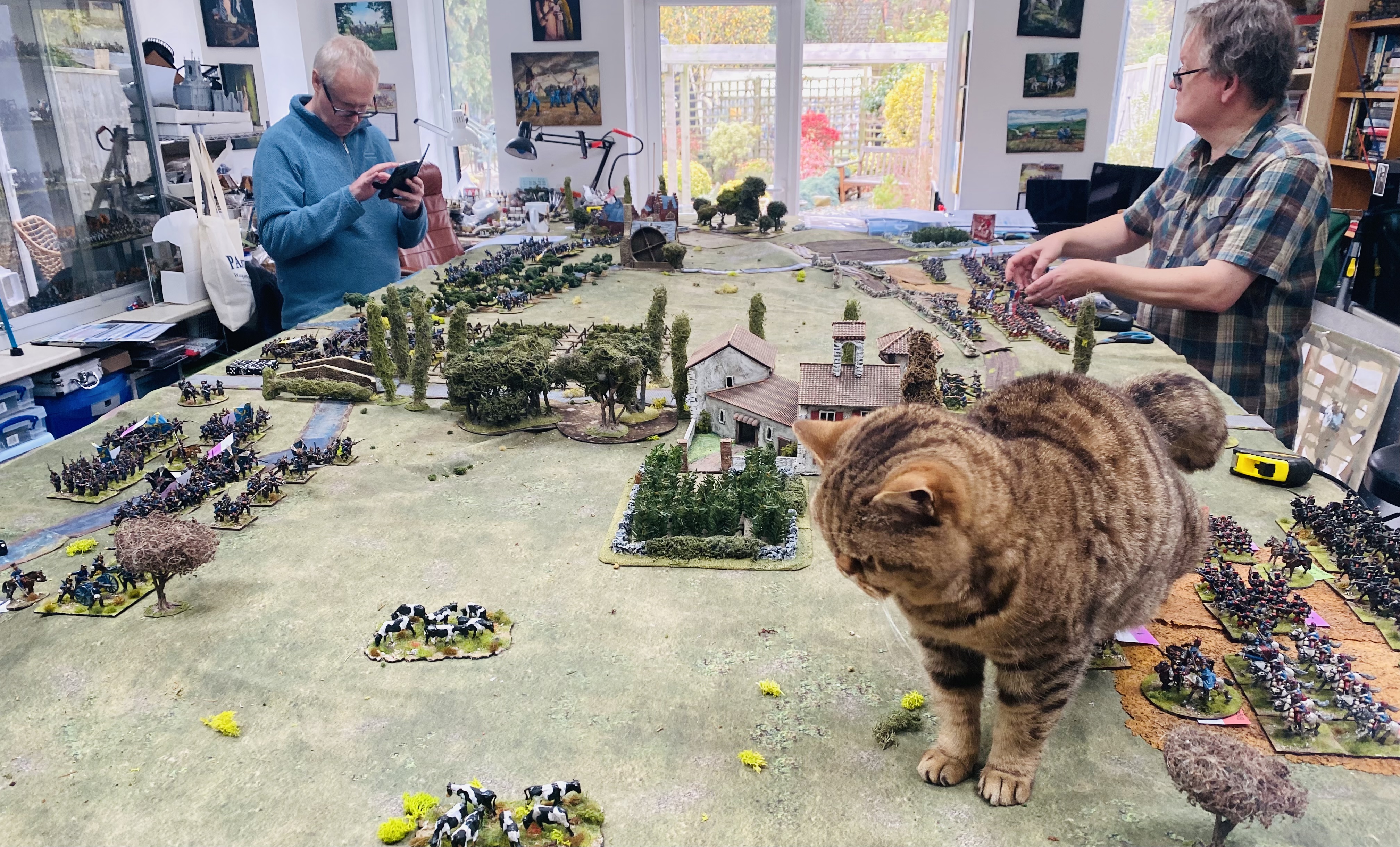 |
| Looking down the table past the cat. |
 |
| In order to divert the attention of the Prussian artillery from my infantry my light cavalry bravely exposed themselves on the left wing, attempting to outflank the enemy on there hill to their front. They nearly made it! |
 |
| The Prussian dragoons wisely keeping out of the way. |
 |
| Two regular battalions about to occupy the field. The third battalion of this regiment can be seen to the left in skirmish order, just before they bore the brunt of three Prussian artillery batteries and fled. Due to a bizarre stroke of luck I managed a double six so got to throw on the 'serendipity table.' This resulted in the Prussian commander panicking and he ran to the rear causing his brigade to falter! |
 |
| Neil's troops in the centre. |
 |
| The village was quickly occupied by two battalions of Colonial infantry. |
 |
| Conrad's infantry in the centre advancing through the vineyards towards the French centre,. |
 |
| Shortly after the earlier photo was taken the Prussian assault is halted in its tracks and the brigade falters. |
 |
| The French right, facing a major Prussian thrust. |
 |
| On the French right the Prussians were pressing forward. |
 |
| Two battalions of infantry secure in the crops, with support from two battalions of Colonial infantry in the village. |
 Von Bredow's brigade of cavalry prepares to advance, thoughtfully masking the Prussian artillery.  |
| Nigel ordered his cuirassiers to charge the French guns. Predictably they were blown away and fled. |
 |
| While the cuirassiers were being shot to bits their sister regiment attacked a battalion of Zouaves. Guess what? The hussars were annihilated. |
 |
| Prussian artillery on their left. Six batteries should have made a big impression on the French lines but they were not well placed and had limited fields of fire. |
 |
| The final attack mon the Prussian right was repulsed and the now faltering brigade had to withdraw. |


