Wednesday, 20 April 2022

And now we go over to the velodrome


At the time of the Winter War of 1939/1940 the Finns equipped their elite jäger battalions and other recce troops with bicycles (swapped for skis when dictated by the weather). Each company also had a section on bikes for messages and the like. 

These are probably more use if I extend my options and start playing the Continuation War but I’m not contemplating that yet!  The figures are a mixture of HaT and Streletz WW2 German cyclists so only needed a paint job to turn them into Finns. Some even have what look like camo ponchos that I have painted white. They’re ok I suppose and I really find it hard to paint 1/72 scale after many years of 28mm castings.

I don’t know how much use they’ll be and glorious bicycle charges across frozen lakes doesn’t seem like a good idea (but no doubt someone will try it one day) but they’ll be handy somewhere or sometime. 


Wednesday, 13 April 2022

A Very Fine Regiment.

 I've been very lucky to be sent another couple of books from Helion to review. In the absence of any games and not finishing much of note here's my thoughts on the latest.

As a Lancastrian born and bred I do of course agree that HM 47th Foot (Lancashire) as they were then, is and was a very fine regiment indeed.

This fascinating book is yet another from Helion focussing on the American Revolution and traces the history of this one regiment throughout its campaigns during the entirety of the from war in almost forensic detail. The author provides us with invaluable insights into soldiering in Ireland and then America, from the early days in and around Boston, to operations along the Canadian border and the disaster that was Saratoga where much of the regiment became prisoners of war. Those fortunate not to be with the main army remained on the Canadian border for the rest of the conflict. If I were to chose, I’d say that the chapters on The Convention Army and that covering the three detached companies that were not present at Saratoga and who continued operations along the Great Lakes for the remainder of the war provided a lot of fascinating information that was new to me.

The author makes great use of contemporary sources, with correspondence and quotations which I always find myself drawn to. The book is well illustrated with a good number of really useful and clear maps, lots of contemporary black and white images and numerous tables. There are of course eight pages of colour illustrations. One is an original specially commissioned for the book, while the rest are a mixture of contemporary images and pictures of modern-day re-enactors dressed in a range of different uniforms and these are nicely done.

There are three appendices, the last one reproducing the rather interesting ‘Articles of the Convention’ between Generals Burgoyne and Gates following the Saratoga debacle.

‘A Very Fine Regiment. The 47th Foot during the American War of Independence, 1773-1783’ by Paul Knight is No.83 in Helion’s From Reason to Revolution series, and is a must for anyone with an interest in this conflict, whether a passing or a serious one, and would be worthy of a place on their book shelves (and mine).

Monday, 11 April 2022

'These Distinguished Corps'


‘These Distinguished Corps’ is one of those books that set me wondering why this subject hasn’t been tackled before. The British army in the eighteenth century was forever forming composite battalions from detached flank (grenadier and light) companies, often operating completely separate from their parent battalions, often in different theatres of war entirely.

This book by Don Hagist seeks to analyse the formation and operations of these elite units during the course of the American Revolution. It takes us through the campaigns in North America and the West Indies from the perspective of the ‘flank’ battalions and presents us with a narrative full of detail as well as action. The use of primary sources allows us to understand the lives of individuals within these formations, who they were, where they served, and their fate. For me this is a wonderful opportunity for anyone interested in the lives of the ordinary soldiers as recorded in their service records, and presents much that is new.

Extensively researched, well written and illustrated throughout with contemporary colour and lack and white illustrations. The eight pages of colour plates in the centre of the book are a mixture of contemporary prints and photos of re-enactors in action, and are well chosen.

No. 80 in Helion’s admirable ‘From Reason to Revolution’ series is a must for anyone interested in these key formations of the British army during the breadth of the American Revolution. Bad news is that I'm now beginning to wish I'd not sold my 28mm AWI collection about seven years ago, but they went to a good home and showed a good return financially so I can't complain. Ive recently some across some .stl files for 3D printing a load of AWI and FIW figures. Tempting......... 


Friday, 8 April 2022

1939 Winter War

I started on this project just before Christmas 2021 and our first game took place last Friday. First of all.  I am not oblivious to the potential for drawing parallels with some aspects of the Winter War and Putin’s invasion of Ukraine - small highly motivated army defending their country versus hugely superior numbers of Russians intent on rescuing the Finnish oppressed proletariat from their capitalist overlords, with more men, tanks, planes, well everything. The initial Soviet assaults were poorly planned and executed and it wasn't until they'd suffered significant losses that they changed their approach and began to make headway against the Finns using their overwhelming superiority in EVERYTHING.. 

On Friday (1 April!) battle commenced with an overwhelming Soviet assault on a lightly defended section of the Mannerheim Line. The terrain was essentially totally covered in woods and areas of frozen ponds and lakes. There were a couple of villages and we had a few areas of ‘dodgy’ ground, indicating either deep snow or frozen pond/lake. The latter were marked with large white areas of card with the warning to be careful going across them. About half the forest and rough ground areas were mine, and the rest were provided by my good mate Tim from the 'Like a Stone Wall' club. For this game we used Iron Cross from Great Escape Games with suitable Winter War mods and some campaign-specific random event cards. Fellow 'Like A Stonewallers' Barry, Bruce, Richard and Togs joined our Richard (P) Steve and myself for the game. I was the Finnish CinC, aided by Richard and Barry, while Bruce led the Soviet masses assisted by Togs, Richard P and Steve. We the Finns had a bunker on the left flank, some minefields strewn out front and a line of entrenchments in the centre which I forgot to put on the table but as the Soviets didn't get anywhere near it I suppose that's ok. The Soviet aim was to capture the exit points for the roads and/or tracks leading off the table behind the Finnish deployment area.

What followed was an incredibly tense game, lots of action but not always a great deal to see. Much of the tension came from the far from united Soviet command, who had different views about making a speedy and overwhelming attack at once.....or not. Anyway, here are some photos that hopefully give an indication of the course of the game, but not necessarily in the right order!

The centre of the table. All the Finns were hidden at the start, marked with real or dummy markers on the table. 

Soviet T26 MG tank engaged by Finnish tank killer teams

On the right the Soviets were held up by a Finnish anti-tank gun, loosing several tanks to its fire before knocking out.

The centre of the Finnish lines.

The Suomi Secret Weapon

All the comforts of home. The Finnish HQ, complete with sauna and field kitchen serving sausage soup.

The Soviets setting up.....

A lone Soviet tank advances against the invisible Finns, while its supporting infantry are bogged down by fire from our bunker.

Soviets reach the river, driving off the Finnish infantry and destroying the AT gun.

Somewhat overconfident Russian tank commander  shortly before his T26 MG tank is destroyed by an AT rifle.

Esme slept here through most of the game!

Another view of the table.

A lone BA-6 or 10 armoured car being used to lure the Finns out of cover.

The Finnish centre is holding. The sacrificial a/c is destroyed by a Finn with an AT rifle. 

Soviet armour on their left flank.

More Soviet tanks.

Looking down the table from the Finnish right.

Barry's Finns were slowly pushed back by hoards of low class Soviet infantry supported by the rather numerous armour.


The Soviets cross the river on our right and secure the road. A similar thing was happening on the other flank.

What an excellent game. The Finns lost the battle (BUT ONLY JUST) as the Soviets had captured two roads on turn six. This was a six-turn scenario with the chance of a seventh, but the random event card drawn in the last turn resulted in a snowstorm descending on the battlefield. The Finns opted to retire under cover of the weather. Finnish losses were light with just a few sections of infantry and a couple of AT guns and  HMGs lost, while the Soviets lost a good half dozen tanks, one armoured car and a fair few infantry squads. The Soviets also lost their CinC when the tank he was riding in ran over a random mine and blew up. It was fun watching the Soviets bicker on occasion about their tactics. If they'd stormed forward with their infantry from the outset they'd have forced the Finns to expose themselves to retaliation from artillery and tanks. But that never happened.

I  need to make some more winter terrain at some point but I enjoyed the game  and the rules a really good.


Wednesday, 23 March 2022

The Sausage War, Finland 1939


On the night of the 10 December, the 718th Rifle Regiment of the Soviet army swung around the Finnish rear of the Tolvajärvi front and attacked the lightly defended Finnish supply and artillery troops at Varolampi Pond situated along the Korpiselka - Tolvajärvi road.


The surprise attack saw initial success by the Soviet troops in advancing through the Finnish supply lines but failed to continue the assault towards Tolvajärvi village and the Finnish main-lines. The Soviet soldiers were exhausted and hungry after 5 days of forced marching and stopped to eat the sausage soup that the retreating Finns had left behind in their field kitchens. 

This gave enough time for Major Pajari, who happened to be along the Koriselkä road at the time, to muster enough soldiers from the 16th Infantry Regiment along with dispersed field cooks and medics to launch a counter-attack.

Fighting lasted well into the night and involved close quarters combat and one of the only cases of bayonet fighting during the Winter War. By dawn of the 11 December, the counter-attack succeeded in driving back the Soviet force and inflicted heavy casualties with over 100 dead Soviet troops left on the field according to Finnish estimates along with 20 dead on the Finnish side.

The field kitchen and all the figures are resin 3D prints that I did myself.


Saturday, 12 March 2022

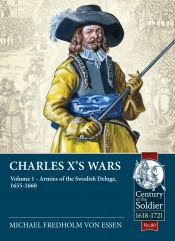
Charles X’s Wars - volume 1, Armies of the Swedish Deluge 1655-1660


This volume has to be yet another feather in the cap for Helion, providing us with the first comprehensive English language account of the army and wars of Charles XI of Sweden, in particular that event better known in Poland as ‘The Deluge’. Now, this is a quite complicated yet fascinating period of history, and one that needs unraveling to help us understand the events leading up to the war and the war itself. This is the first of three planned volumes on the war, and this one, Charles X’s Wars. Volume 1 - Armies of the Swedish Deluge 1655-1660 by Michael Fredholm von Essen certainly sets the bar high for the volumes to follow. 

The author focuses on the armies that were involved in the ‘Swedish Deluge’, fought between Sweden, the Polish-Lithuanian Commonwealth, Brandenburg-Prussia, Muscovy, Transylvania, the Cossacks of the Ukraine, the Tatars of the Crimea and the Holy Roman Empire. A glance at a period map will show that just about every nation in Eastern Europe was drawn into the war, so researching and writing a book on such a broad subject is to be commended.

After a brief introduction, a very detailed and informative chronology (really handy for those like me who need a few dates to help register what’s being described), together with a very comprehensive gazetteer of the great and the good, by nation. There are also some far more detailed and fascinating biographies of eight of the main contenders, including Charles X of Sweden, John Casimir King of Poland, Frederick William, Elector of Brandenburg, Tsar Alexis I of Muscovy, the Cossack Hetman, the Prince of Transylvania, the Holy Roman Emperor and the Khan of the Crimean Tartars.

The complex and sometimes misunderstood origins of the conflict are explored and explained before generous chapters are given over to the armies of each of the combatant states. All of these provide a good level of information, including their organisation, troop types, dress, arms and tactics, and where possible, details of the regiments that made up the various armies. Personally I found the chapters on Brandenburg and Tartars, and to some extent the Empire, particularly interesting as they offered a lot of new (to me) material.

The book as a whole benefits from an excellent and prolific range of contemporary black and white illustrations, photographs of arms and armour and a few nice black and white sketches. The star of the book for me are the eight pages of original colour artwork by Ukrainian artist Sergei Shamenkov, depicting a beautifully drawn selection of different troops from the various combatants’ armies.

So, an excellent book, and a tantalising first volume of what will no doubt be a fascinating and information-packed series.


Monday, 7 March 2022

‘Rebellion, Invasion and Occupation; The British Army in Ireland 1793-1815.

British military involvement in Ireland during the latter part of the eighteenth century and early part of the nineteenth is a rather complex and often unpleasant tale. ‘Rebellion, Invasion and Occupation. The British Army in Ireland, 1793-1815’ by Wayne Stack does an excellent job in explaining the army’s role and operations in the field against rebellious Irish and French invaders.

The book makes for a fascinating read, as most of what the book covers is relatively virgin ground for me, which makes it all the better. We start with a detailed section covering the prelude to the rebellion and then the events and battles that took place as it ran its course. No book such as one this size could hope to encapsulate the account of the rebellion completely as it would need as far larger book to do the subject complete justice. However, what it does provide is excellent, and from a wargamer’s perspective it is nigh on perfect, although author quite rightly does not shirk from mentioning the many instances of atrocities that took place throughout the campaign, which helped create the shape of the Anglo-Irish relationship for decades to come.

We then get to the juicy bits of the book; the organisation, location and dress of the multitude of Militia (38 btns) and Yeomanry regiments in Ireland and the large British garrison prior to 1798, made up of regulars and fencible battalions. Indeed the latter played an essential element in the defence of the country, with 12 regiments of fencible cavalry and 34 battalions of fencible infantry serving in Ireland. One detail that had previously escaped me was the fact that a third of the fencible cavalry and two thirds of the fencible infantry were raised in Scotland! No mean feat. Sadly their performance, for the majority, was not good and they proved unfit, ill disciplined, ravaged by sickness and generally susceptible to the rigours of campaigning. Reports of atrocities by them on the civilian population abound, although some few units were up to the standard needed to perform the duties expected of them. (I had to smile at the thought of the Prince Of Wales Fencibles arriving in Dublin, only for the majority to be sent straight back to England as they were judged to be ‘too fat, too small, too infirm and too young’).

A large proportion of the book is devoted to the 1798 Rebellion and the defeat of the French invasion, and these aspects are dealt with in detail, with the descriptions of many of the skirmishes and battles being especially useful. Of course the defeat of a rebellion of such magnitude meant a greater British presence in Ireland, and a rethink of the roles and usefulness of the militia and Yeomanry, especially given the poor showing of the former and general low esteem that the militia were held in by the British commanders in Ireland.

The appendices are a mine of information, covering among other subjects, the garrisons or locations of the vast numbers of largely Catholic militia, mostly Protestant Yeomanry, regulars and fencibles that were called to arms of deployed to face the very real threat caused by the rebellion. There are also half a dozen very useful orders of battle for battles such as Arklow, Vinegar Hill and Castlebar to name but three.

Illustrated throughout with many contemporary black and white illustrations, a good number of very clear and helpful maps, and the usual centre spread of colour plates. One is an original, commissioned for the book while the remaining seven pages are some very colourful examples from the Anne S.K. Brown Military Collection depicting the uniforms of the many different troops that took the field against the Irish rebels and French, as well as a couple of examples of the Irish and French troops.

This is No 81 in Helion’s From Reason to Revolution series and will definitely find a place on my book shelves. As ever I can recommend this book most highly.