Friday, 20 January 2023

20mm 3D printed European Buildings

I think I must have had a rush of blood to the head or something as I present here yet more buildings from  the awesome and extensive range of .stl files available from shop@najewitz.de. Adequately painted by me.


And no I am not going to build all of Leipzig!


Thursday, 19 January 2023

Lots of Valour but lacking in Fortitude……

 ……on my side of the table at least. On Tuesday afternoon John the Red and I tried out the new Valour and Fortitude fast play, back-of-a-fag-packet rules from the Perry Twins and Jervis Johnson.  We kept things simple with two brigades of infantry, a brigade of cavalry and a battery of guns each, although to maintain my preference for asymmetrical army composition the French had an extra battalion, compensated for by the British having a battalion of Footguards.

The battlefield. Brits on the left.

John took the French. I was using troops from my Revolutionary Wars French and British collections as I don’t own any ‘proper’ Napoleonic Wars armies. (John pointed out correctly that actually I do, with 1806 Prussian and Saxons and 1812 British and Americans, but no French). I’d set the table up for a straight meeting encounter with both sides fighting to control the crossroads, bridge and the plateau. 

The British right flank. Very smart boys!

The British light dragoons, deployed impotently on my left.

I will give my feedback on the rules at the end but here are some photographs of the encounter with a few words of explanation. The official (i.e. mine) view is that as the game was a play test normal restraint and common sense went out of (my) window. Read on………

The Footguards make their way through the town beneath the heights.
My 1st brigade advanced boldly up the road towards the enemy centre. My combined flank company battalion was swept away by a column of French infantry.
My Guards battalion was left isolated and assailed from the front and the flank. They held on for a turn but then broke, marking the end of my 1st Bde.
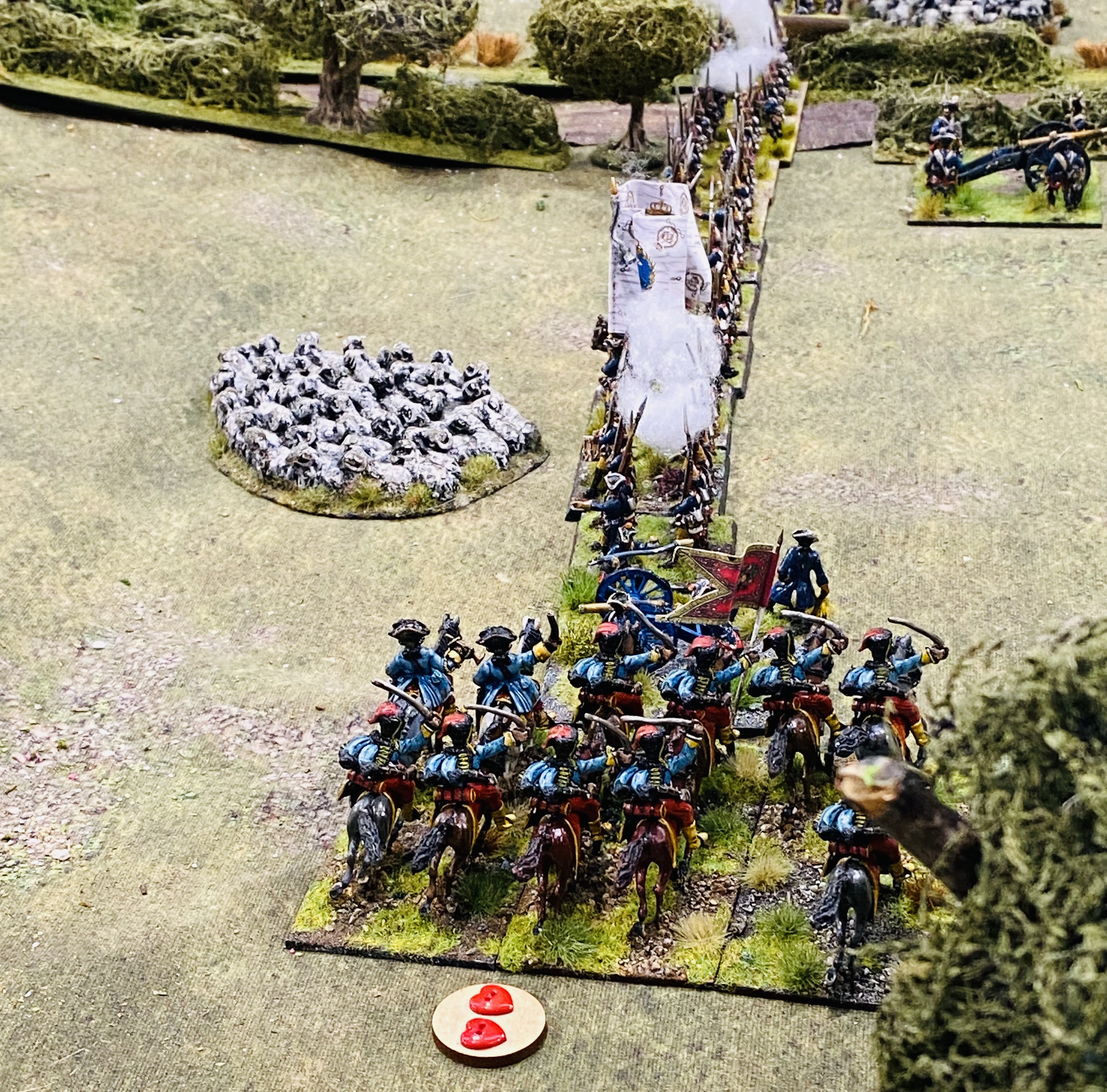
My second brigade’s advance was halted by the appearance of the French cavalry brigade, forcing them into square.
British (mainly Scots) rooted to the spot. Even such a wonderful target for the artillery as a brigade of enemy cavalry didn’t improve their accuracy. Even when they were charged by the French they were hopeless but did hold on until round two of the melee when they ran.
I decided to switch flanks with my cavalry and they began an epic gallop from the left to right flanks.
My light dragoons swept from one flank to the other taking more than just the odd casualty from the French centre before they charged into the enemy chasseurs a cheval.

My force was shattered. One brigade of infantry had broken, as had my cavalry brigade (those ‘odd’ casualties taken during their ride from one flank to the other proved to be disastrous). My remaining brigade less the artillery was pinned in square and unlikely to be able to escape. An absolute disaster for the British!

We made loads of mistakes early on in the game but once we got into them the rules worked well. We did have a number of queries, the solutions to which don’t seem to be covered by the rules. These include:

  • Are skirmishers allowed to evade?
  • Likewise, can artillery try and bug out if charged?
  • Artillery seemed to be weak and a waste of space.
  • Absence (so far as we could see) of closing fire means that a cavalry unit can start a charge outside of musket range and make contact without taking any defensive fire. This cannot be right surely? 
  • Countercharges and forming square as a charge reaction don’t seem to figure in the rules?
  • The special rules for each army were just enough.
  • The use of a customised deck of cards for each army is not too gimmicky nor do they have a too heavy impact on the game.
  • What happens at the end of a melee if neither side breaks or it is a draw? 
If any more queries spring to mind I shall add them here. I did enjoy getting thrashed and am looking forward to another run out with them.

Big game here again on Saturday coming. 


Wednesday, 11 January 2023

20mm European Building

I finally finished this piece this afternoon. It’s a 3D print of one of the gates of Leipzig rather averagely painted and based by me.


I’m still preferring 20mm or 1/72 scales buildings for 28mm games as they have a small footprint. If you recall I have lots of scruffied up HO railway models and they work fine imho. The hussars in the photo are 28mm and I don’t think they look out of place and they certainly won’t with thousands of miniatures on the table! 

I’ve a few more 20mm buildings to finish, mainly for the Fall of France but some more from the excellent Leipzig range.

Sunday, 8 January 2023

"I think the King will lose this day" said Marshall Daun before Kolin. Was he right?

The first game of the year was played out yesterday, a large refight of one of my favourite Seven Years War battles, Kolin. It was a full house, and Conrad, Richard, John the Red and Nigel were the Austrians while Dave, Paul, Shaun and John H were the Prussians. I decided to use Black Powder with some of our usual house rules.

Notes on terrain. Troops shooting through or into the standing crops did so at -1. The hedgerows and tracks are representing sunken lanes. Troops in the sunken lanes benefit from cover but if behind the hedges themselves they do not. 

The game about to kick off. Prussians looking worried on the left. Austrians also looking worried on the right.
The bulk of the Prussian army is either not yet on the table or strung out in column along the road, overlooked by the Austrians to their right. Shaun anxiously looking over his right shoulder towards their reinforcements.
The Austrian left wing. Thankfully for the Prussians these troops were not allowed to activate until turn four, or if the Prussians came within 24" of them.


The Austrian centre from their rear. Grenz and a lone battalion of grenadiers and a battery of artillery.

On the Prussian left, their hussars quickly became embroiled in combat with their Austrian counterparts.  By turn two the Austrians had defeated all four regiments of Prussian hussars thanks to some unusually bad dice scores from Paul, although the Austrians would say it was down to their tactical brilliance!
The flight of the Prussian hussars left the flank of their attack exposed and open to attack. The Austrians charged but superior discipline and some better dice rolls meant the Prussian grenadiers beat off the enemy attack, although their supporting artillery was overrun.

The Austrians tried to exploit their victory against the Prussian left but were countered by a brigade of Prussian cuirassiers. Sadly for the cuirassiers, by this time Nigel had brought his Saxon cavalry and attached Austrian elites forward, and the Prussians were pushed back and broken. 

In the centre after a delay the Austrians finally got their troops to move in order to counter the Prussian onslaught in the centre.


The Prussian attack in the centre captured the old Swedish earthworks and drove most of the Grenz out of their positions.

I should have expected this move from Conrad, as two brigades of heavy cavalry posted behind their left wing rapidly advanced against the Prussian right and suddenly surged forward for three moves as he'd thrown something ridiculously low. Eight regiments is a scary sight.

The presence of so much Austrian cavalry meant that the remaining Prussians due to arrive along the road were delayed and at no little risk once they appeared. The lead battalion (IR 15 Garde) did deploy to cover the entry of the rest of the brigade. They did not shoot such a tempting target as we only allow infantry to move once and still fire.

John H and his remaining troops arrived a turn late, which was to prove a critical delay.

Conrad's cavalry swept away a brigade of Prussian dragoons and a lone cuirassier regiment and galloped along the enemy baseline, pursued by John H's infantry and cavalry. 

The Austrians were held up by the valiant efforts of IR40, who survived a flank charge, reversed their rear ranks and prepared to sell their lives dearly. 

John's Prussians advanced against the Austrian left wing under Richard,  ignoring the threat of enemy cavalry to their rear as four regiments of Prussian cuirassiers had just arrived.
                              
The Prussian right, with Conrad's Austrian cavalry in the distance behind the Prussian lines. 

Austrian and Saxon horse on the Prussian left.

The Prussian left, crumbling under the pressure from the Austrians, and due to Paul's continued and statistically unfair dice rolling!
Austrian cuirassiers seen through a window in one of the villages they rode past.

John the Red's infantry made it to the sunken lanes and began trading shots with the Prussians. Attack over.

I did a quick roll call and it showed that the Prussians were in deep trouble. Their hussars and cuirassiers on the left had been destroyed and the infantry attack in the centre had been stopped, due largely to a dogged Austrian defence but also to the presence of enemy cavalry on their flanks and rear! Only on he Prussian right was anything going reasonably well, but it was too late. John H's infantry had driven back Richard's Austrian battalions and his cuirassiers had caught up with Conrad's roaming horsemen in the rear of the army. However, by now over half of the Prussian army brigades were in retreat, off the table or were broken and retiring. Many of the troops in the centre would be unable to retreat due to the Austrian cavalry and would be captured. In fact only John H had troops actually under orders!

All this and it was only 2pm real time, and after no more than six turns the Prussians had been comprehensively defeated. Quite an achievement but there was definitely something awry with the Prussian dice rolling yesterday. Conrad's mad charge around the Prussian army would probably not have happened or been as successful if he hadn't been able to get the three moves needed to cross the battlefield and thus delay the Prussian reinforcements. The Prussians needed these infantry to press home the attack but they had to do without them.

This was a splendid game and despite the early finish was thoroughly enjoyable. It was also a major boost to my gaming mojo after a couple of months of illness, uncertainty over my wife's health and a touch of le cafard. Black Powder worked really well again as usual. While not my favourite ruleset for the SYW they're easier to manage than, for example, Honours of War, where the alternate move and fire system for opposing brigades would have slowed things down significantly, and not everyone is familiar with Paul's Panoply of War set. Everyone is familiar with BP and they work for big games such as this.


Wednesday, 4 January 2023

New Worlds, Old Wars review.


Number 92 of Helion’s Century of the Soldier series is another, not quite niche topic, covering the Anglo- American Indian Wars between 1607 and 1678. Author David Child’s has done an excellent job presenting a very readable account of the establishment and growth of English settlements in North America. In Europe, the great powers were busy fighting and bleeding each other dry in pretty much continuous conflicts such as the Thirty Years War, the British Civil Wars, various Anglo-Dutch and Anglo-French conflicts. Meanwhile across the Atlantic these same powers, although primarily the English (British), were busy establishing settlements and fighting the indigenous population (not always successfully) and each other for the much coveted wealth of the New World.
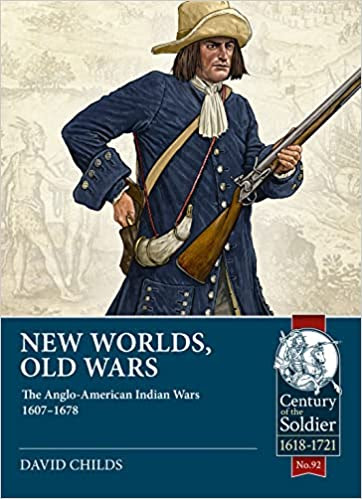
This is perhaps remarkably the first book I have read on the subject. While not making excuses for the behaviour of the European settlers towards the Native Americans, it remains a fascinating account of the period, focussing on the Powhatan Wars of Virginia, Smith’s War 1607-1609, Dale’s War 1609-1613, then moving to New England for the Pequot War, and King Philip’s War and the Abenaki War in Maine between 1675 and 1678. These were not massive European-sized conflicts, but equally bloody wars of ambushes and massacres, and the descriptions give a good insight into how the Europeans and Native Americans set about trying to destroy each other. Indeed chapter 10 is entitled Conclusion and Consequences- How the East was Won. Here, the author sums things up nicely. The Native Americans were doomed to loose, despite their often superior tactics and field craft, and we learn in detail how and why the Europeans slowly eradicated any threat posed by the indigenous population.

The book is well illustrated throughout with a wide range of contemporary and present day black and white images and includes several interesting maps of the Colonies (again, both contemporary and modern). A good selection of appendices finishes off the book, where we are able to read, among other things, examples of contemporary correspondence, both official and private.

I really loved reading this book and I learnt a great deal from it, and Helion are yet again to be commended for bringing topics such as this to our attention. If you have an interest in the early days of the colonisation of the east coast of North America (Virginia and New England specifically) then this book is for you. Highly recommend.

ISBN 978-1-915113-99-3. 201 pages.

The Next Helion Conference

This looks interesting. I wonder if I will be able to make it.


Sunday, 1 January 2023

Fall of France 1940: WW2 French St Chamond 193mm howitzer

More stuff completed as the holiday period comes to an end (unless you’re retired in which case it’s one big holiday). I thought I’d do another piece for the 1940 French. I doubt I’ll ever use it except as an objective of some kind.
The ultimate (almost) in silliness. I saw this model before Christmas and just had to buy it (Mad Bob Miniatures). It’s a resin 3D print in 1/72 scale and is east enough to assemble except for the railings which a bit of nightmare trying to glue and then keep glued in place round each vehicle. I might have to replace them with wire in due course as I doubt they’ll survive their first game.
I’ve done them in travelling mode. 
The ammo carrier.


The complete model. I am rather pleased with it.