Saturday, 21 May 2022

Colonial Ironsides review.

Devotees of all things from the Commonwealth and Restoration period of British history will be pleased to see this book The Colonial Ironsides, English Expeditions under the Commonwealth and Protectorate, 1650 - 1660 by Jonathon Riley. This book joins several previously published Helion books covering this era, two volumes on the Anglo-Spanish War 1655-1660 and the author’s own The Last Ironsides, gives us a wealth of information on a fascinating yet somewhat obscure subject.

This book provides a fascinating account of a less well known and studied decade of military operations, the results of which helped shape Britain’s future for centuries to come. Chapters include operations against the remaining Royalist holdouts in the Scilly Isles, the Channel Islands and the Isle of Man, and campaigns against the Spanish in the Caribbean and the Dutch in New Amsterdam to mention a few examples. Also important to the scope of this book are the Commonwealth’s campaigns in Europe, including the Battle of the Dunes and the siege and occupation of Dunkirk. I particularly liked the chapter describing the formation and operations of the Royalist army in exile of Charles II as he struggled to gain support for an attempt to invade and regain his father’s crown.

All of these campaigns are examined in great detail, and provide the reader with a wealth of information on such things as the leaders, political aims, the troops and ships involved, lots of potentially ‘heavy’ stuff which is in fact described quite clearly and fluently. Each chapter has its own dedicated appendix following directly on rather than all being at the of the book. It’s a different approach and one that in my opinion works well for this book given the vast amount of information being provided.

The book is very well provided for in terms of detailed and helpful maps of the theatres of war, many which being reproductions of contemporary prints. There are also a significant number of contemporary black and white images and numerous tables detailing the men, units and ships involved in each campaign.

To sum up, yet another highly recommended Helion masterpiece to fill a space on the bookcase. Readers ought not be disappointed in this excellent book. I wasn’t.

Thursday, 19 May 2022

The Asienus Gladiator No. IV - More News from the Late Roman Campaign


The latest edition of the renowned news tablet focussing on the day to day events in the province of Asienus. In this issue an interview with King Uiscabar of the Huns, news of another bloody battle, and a run down of the local and empire-wide news stories.


More next edition.


Tuesday, 17 May 2022

An interesting find…….

These are 1939 Winter War Soviet infantry. They produce a good range of figures, equipment and vehicles.

It will not have gone unnoticed that I’ve gone over to the dark side and dipped my toe (or more like my whole leg!) into early WW2 gaming, in the shape of the 1939-1940 Winter War. In my search for suitable miniatures (and because I wanted to jazz up the many Strelets plastic  figures already in my collection. These detailed and quite dynamic figures are from a company I’d never come across before called 1/72 Scale Miniatures, webstore  Here. They appear to be British expats based in Spain and the turnaround of the mail order service is about 10 days or so (based on my limited experience) which is fine. 

The figures are either metal or resin of some sort, and whatever medium is used the detail is good. Overall I’d say for me they represent good value for money.

Second Sino-Japanese War Nationalist infantry.

More Nationalists - command and ‘big sword’ troops.
More Soviets with rifle grenades

The Chinese are part of an extensive range and will go nicely with the box of Caesar Miniatures plastic Chinese Infantry. If I can ever get my 3d printer set up I shall run off a load of AFVs and other vehicles for both the Chinese and Japanese.Why not?

Monday, 2 May 2022

They’re no Snow Angels……1939 Winter War game

 A bit of a challenge on Saturday, when I exposed the guys to something largely outside most of their comfort zones, the 1939 Winter War using Great Escape Games' excellent Iron Cross ruleset with some period specific amendments which I know worked fine last time I played. Ultimately there were seven of us; Paul, Shaun and Nigel were the Finns and Dave, Conrad, Neil and John were the Soviets. I tried to remember the rules and umpired/hosted. The figures are a mixture of 1/72 scale metal castings and Strelets plastics. Most of the vehicles and AFVs were 3D prints (several by me) or Early War Miniatures, Minirons or Pegasus. All the terrain is mine, much of the wooded and broken ground areas I made myself; the exception being some 'winter copses' I picked up off Andy at Last Valley. This game was a bit of a risk as, (a) I wasn't totally up to speed with the rules, (b) most players were not 'into' twentieth century wargaming so might have struggled a bit tactically and (c) with hindsight I hadn't prepared enough for the game beforehand. I knew what the troops represented but the players were confused. Ah well, I shall colour code them all for the next game, the troops that is, not the players, although.......?

Finns on the left. Their main line ran from the villages at each end of the table roughly following the long road that can be seen heading off into the distance. The other road running right to left (east-west) across the table was meant to be a 'decent' road, and is the main axis of advance for the Soviets. The Finns had a couple of bunkers, a few lengths of barbed wire and some anti-tank traps to deploy as well as three minefield markers (only one was real)

I will do the usual and run through some photos of the action with explanations as and when I feel necessary and/or can remember. I think they're all in the correct order.....and trust it all makes more sense to the readers than it did to me and some of the players!

In the centre the Soviets won the initiative and under Conrad brought on the best part of two platoons of infantry and a company of BT-7 fast tanks, followed by a T26 (twin mg version) and two OT-26 'chemical' tanks (flamethrowers to me and you). Over on the right a card played by the Soviets caused three hits on a random Finnish unit as they had been mauled earlier by Soviet cavalry patrols that had interfered with their supply situation. This random unit just happened to be the one holding the village of the Finnish left.

One of the Soviet objectives was to locate the Finnish airstrip and eliminate it. The strip is guarded by a venerable ex-Czarist Putilov howitzer

One of the other objectives of the game was to locate and recover a broken down Russian experimental tank. In reality the Soviets only had a single prototype of the SMK-1 (named for Sergey Mironovitch Kirov), tried it out in action and lost it when it broke down. The Finns tried to capture it but were unsuccessful. In the game the location of the tank was unknown to either side but was quickly found by a platoon of Soviet infantry.

The local church. No doubt being used as an OP.
Conrad's BT-7 company under fire from hidden anti-tank guns.

Behind the church the Finn secret weapon, their field kitchen!
                              
Conrad's BTs took some damage from enemy AT guns but made it over the 'alleged' minefield on the crossroads without incident.

Dave's infantry survived a hopelessly off target Finnish airforce strafing run and fire from enemy riflemen and drove the already weakened Finnish defenders out of the village on the right wing and pushed on across the open fields.

The Soviets drew a card giving them air support in the shape of  an SB-2 bomber. The Finns had been holding a fighter support card so played it, and a Fokker XXI arrived and drove the enemy bomber off.

The Finns threw in their elite reserves to try and retake the bridge, but were to be foiled by shots from a company of T37 amphibious tanks that can just be seen on the bridge.

The  (empty?) Finnish left wing.

While the BT-7 company braved the minefield John's unit of OT-26 chemical tanks  and twin-turreted T-26's struggled. One chemical tank was blown up by a well-placed Finnish AT gun and the other got bogged down in deep snow. The other T-26 MG  never even made it onto the table.

Soviet T37 and T38 amphibious tanks advance through the minefield, which turned out to be another decoy.

Probably the final straw for the Finns as the last Soviet tanks arrive; a company of five T26 light tanks.


More action in the skies......just for show but why not?

The last of the Finns in the shape of a platoon of cyclists. Not much use in deep snow.....

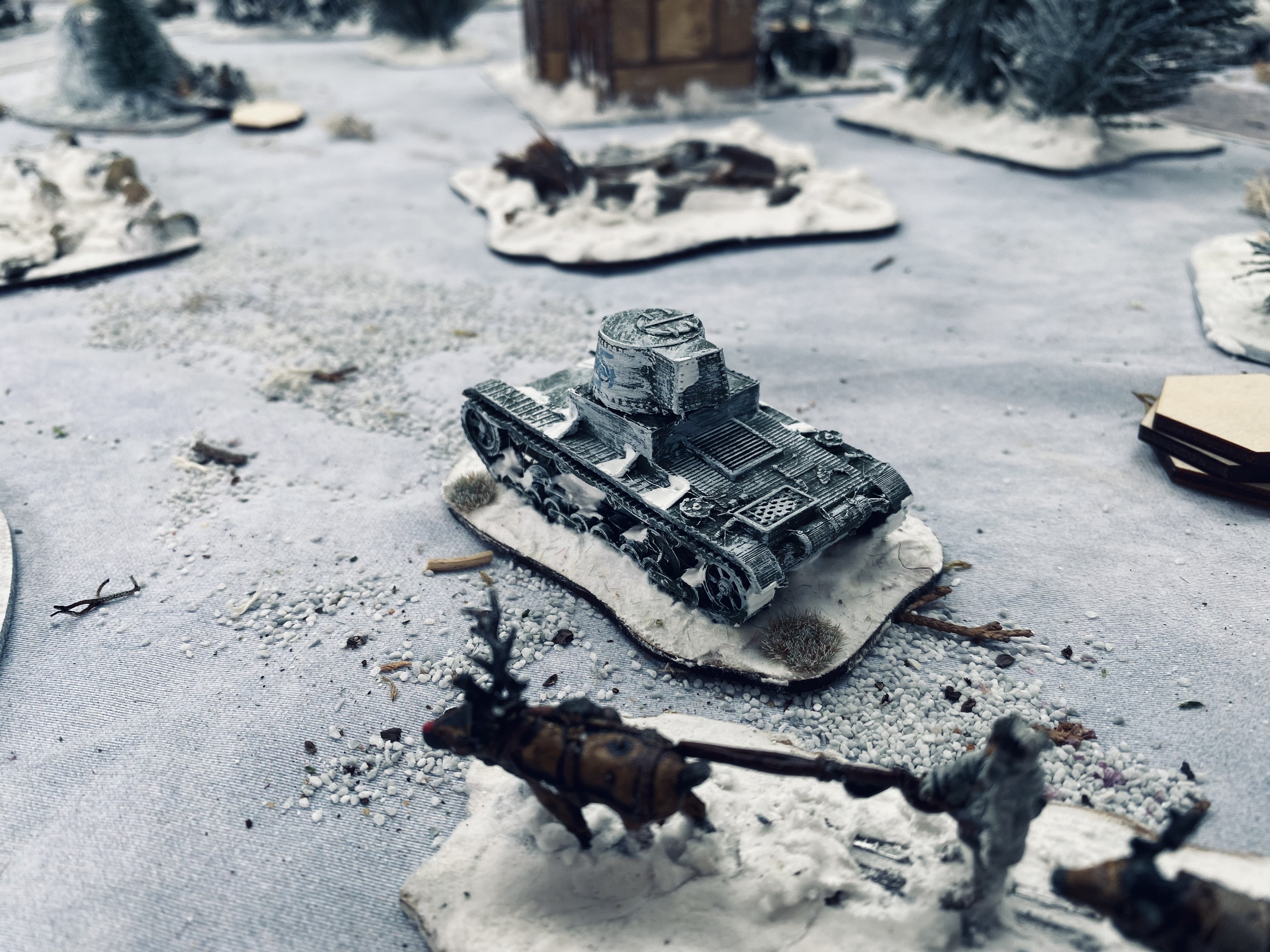
A lone Finnish Vickers 6-ton tank holding their left almost alone.

At the end it was a clear Soviet victory. Finn losses were negligible but they had lost both villages, the   bridge and one of the main road exits, AND the Soviets had located the abandoned SMK-1 prototype tank (it was the precursor of the KV-1 and KV-2 tanks). Soviet losses amounted to two tanks and some infantry, but nothing compared to what I'd expected them to loose. The Finns were judged to have slipped away to fight another day, while the Soviets consolidated  their positions.     

I like these rules but am open to suggestions so long as no rebasing is required. I wasn't completely happy with the game if only because I made quite a number of mistakes with rules and the game didn't 'flow' as I'd hoped. Bouncing so many non-twentieth century wargamers with this scenario/period may not have been such a good idea but who knows? So long as everyone comes back!  We have an Ancient campaign game to fight!   

Thursday, 28 April 2022

On the Borderlands of Great Empires, Transylvanian Armies 1541-1613.

In the absence of any recent games or finished troops to share here is another book review. I have to say this one is a tremendous read and I feel privileged to be in a position to share my thoughts on yet another Helion publication.

Florin Ardelean’s ‘On the Borders of Empire, Transylvanian Armies 1541-1613’ could arguably be catering for an especially niche audience in the English-speaking world, but I think I would disagree. The wars against the Ottomans during this period seem to attract a pretty high level of interest, myself included. Helion have added yet another cracker (as if that could even be thought possible) to their ‘Retinue to Regiment’ series.

The Principality of Transylvania was born out of the collapse of the Kingdom of Hungary, and the Eastern half of the defunct kingdom rose out of the ashes to become a distinct independent state and a major player in the never ending wars between the Ottomans and the Hapsburgs between 1541 and 1691.

The author describes how the rulers of Transylvania were able to organise and defend their newborn country from its inception until 1613. The book starts with an excellent and detailed account of the birth of the Principality, including descriptions of the key personalities involved and the different strata of society, from the nobility down to humble peasant.

The following chapters provide a fascinating insight into the organisation and composition of the Transylvanian army, details of the numerous fortifications and lastly an account of the numerous campaigns, battles and sieges that took place during the period covered by the book. This last chapter is excellent and gives an interesting insight into several of the key battles that helped shape the Principality and an analysis of how changes in the ‘Art of War’ influenced the army and the Sate.

It goes without saying that the book is lavishly illustrated with numerous mostly contemporary black and white images, several really helpful maps (including several of the battles) and the usual splendid colour section of eight pages of specially commissioned plates depicting the various troop types to be found in the armies campaigning in Transylvania. These are some of the best illustrations I’ve seen in a while and if I had the space I’d without doubt have some of them on my wall.

Overall then, an excellent book, well written, introducing us to a fascinating and somewhat obscure subject not until now easily accessible to Anglophone readers. I’d recommend it highly.


Saturday, 23 April 2022

No Want of Courage - The British Army in Flanders 1793-1795


Another book review. What a splendid addition to the ‘From Reason to Revolution’ series from Helion. Over the last couple of years we have certainly not wanted for books on the Allied Flanders campaign during the War of the First Coalition either (not to mention two cracking books on the Helder Expedition of 1799). 

As someone with a real fascination in the War of the First Coalition ‘No Want of Courage’ is another gem from Helion and the ‘From Reason to Revolution’ series, number 85 no less! Where other recent books on the period have largely been focussed on a narrative of the campaign, the author here has concentrated on the administration of a British army in the field in the late eighteenth century. Essentially how did it work, what were its strengths and weaknesses? With that in mind, we are given a detailed account of the campaign with all its triumphs and disasters which sets the scene and puts everything in context for the following chapters, which provide a fascinating insight into the operations of all elements that made up the army on campaign. These are the staff, the commissary at, medical services, the regiments, and the ordnance, where the not always especially effective relationship between the Army proper and the Board of Ordnance is discussed. The chapter covering the regiments can be further divided into the restructuring that took place in 1783 following the American war, the administration of the army, training and conditions of service, mobilisation, recruitment, the infantry and cavalry regiments on campaign, and the role of women within each regiment. There is a particularly interesting section on the earlier mobilisations of 1787 and 1790, of which the former turned out to be a complete failure and the second less so as lessons were learnt and applied then put to the test.

I also found myself drawn to the section discussing unit effectiveness in the field, where battalions brought up to strength with large numbers of recruits were sent to Flanders and judged to be totally unfit for service, a situation repeated many times before and since, for example Holland in 1799. Several hundred men were even sent back home they were of so little use!

The book concludes with several interesting and useful appendices covering such topics as strength and casualty returns, magazine states and march discipline. There is also a section covering the siege of Valenciennes and details of the train of artillery attending the British army in the Low Countries. Not counting the regimental artillery the army does not seem to have been especially well off for heavier cannon in significant numbers, which comes as no surprise.

The book is well written and illustrated with a large number of colour and black and white contemporary images and several well-drawn maps including one of the siege of Valenciennes and the surrounding area which is the best I’ve seen.

If you have an interest in the British army or the French Revolutionary Wars, whether as a historian or a wargamer, then this book should certainly be one to add to your collection.  I am also keen to get back to gaming the campaign as soon as practicable. I have a few thousand figures that need to get on the table as it’s been well over as year since they were last out.