Friday, 4 November 2022

On Sunday I went to FIASCO and other stuff on parade

John and I nipped down to FIASCO in Leeds on Sunday. It is held at the Royal Armouries which is always a bonus. I hadn’t been to FIASCO since well before lockdown and as I had missed The Other Partizan was keen for an expedition south.

First of all the show. Possibly (but probably not) because of my growing curmudgeonly nature I am struggling to find much actually good to report beyond having a good day out and plenty of hobby related chat with John, Richard, John Reidy and Robbie albeit briefly, and the few other friends and acquaintances I spoke to.The games were pretty average with the exception of an excellent Italian Wars game from Ken ‘Yarkshire Gamer’ Reilly (the only game played in natural lighting) and a 16thC(?) Chinese v Burmese game using the excellent range from Tiger Miniatures. Sadly, it was so dark inside that  it wasn't feasible to take any photographs, which is a shame. Even with a flash! The dim lighting also meant that browsing some of the traders' stands was extremely difficult and in a peculiar piece of unfortunate serendipity Badger 3D Creations were in a very dark unlit and Stygian-like corner. It was also difficult to browse many of the other traders stalls due to the gloom. 

I did manage to find my way round the hall and bought some MDF bases off Pendragon, a box of Atlantic Goth infantry (like I need any more!) and a vast amount of standing corn/maize crops that had been somebody’s last year’s Christmas tree. Overall not the best of shows but a fine day out nonetheless.

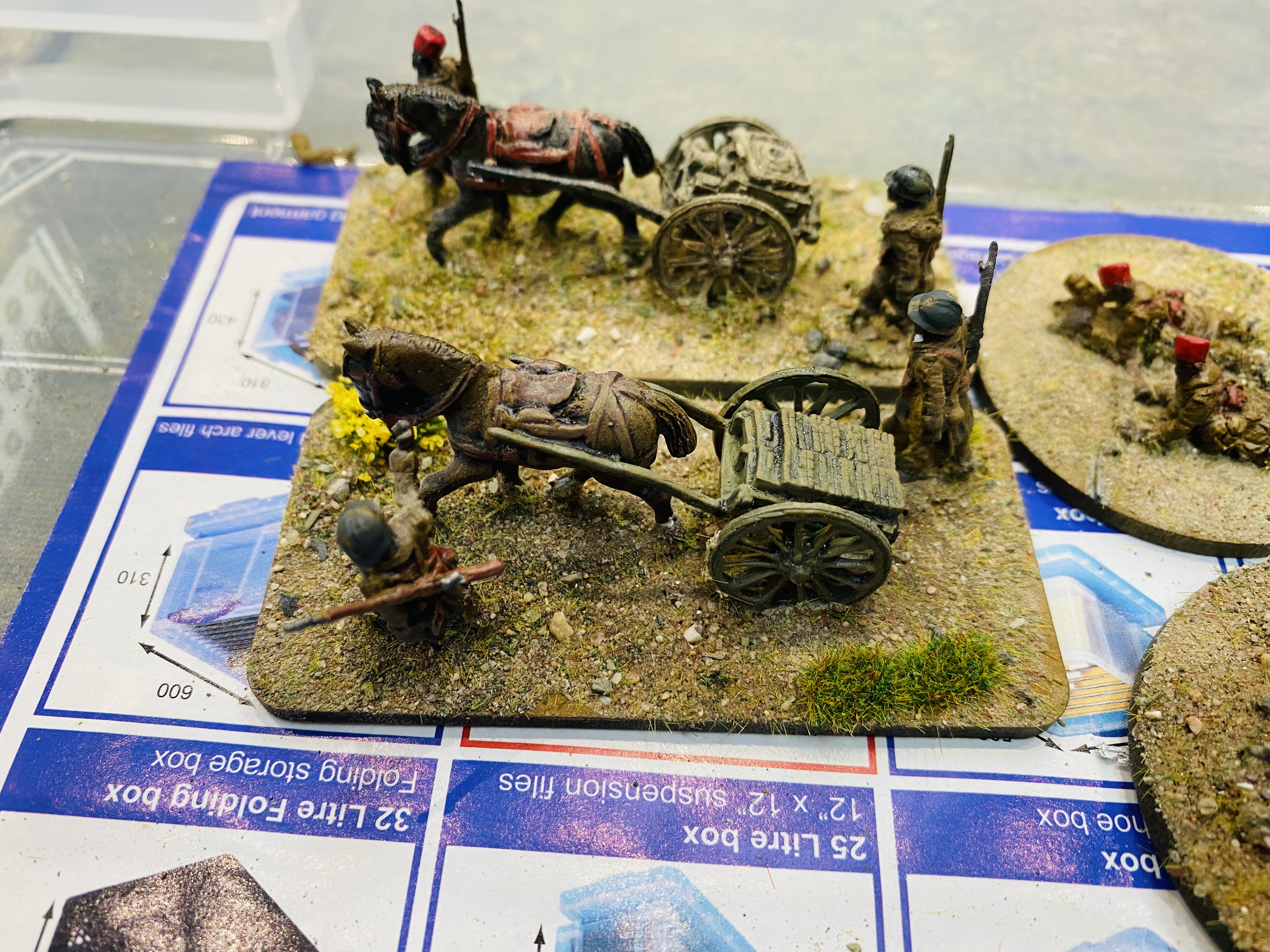
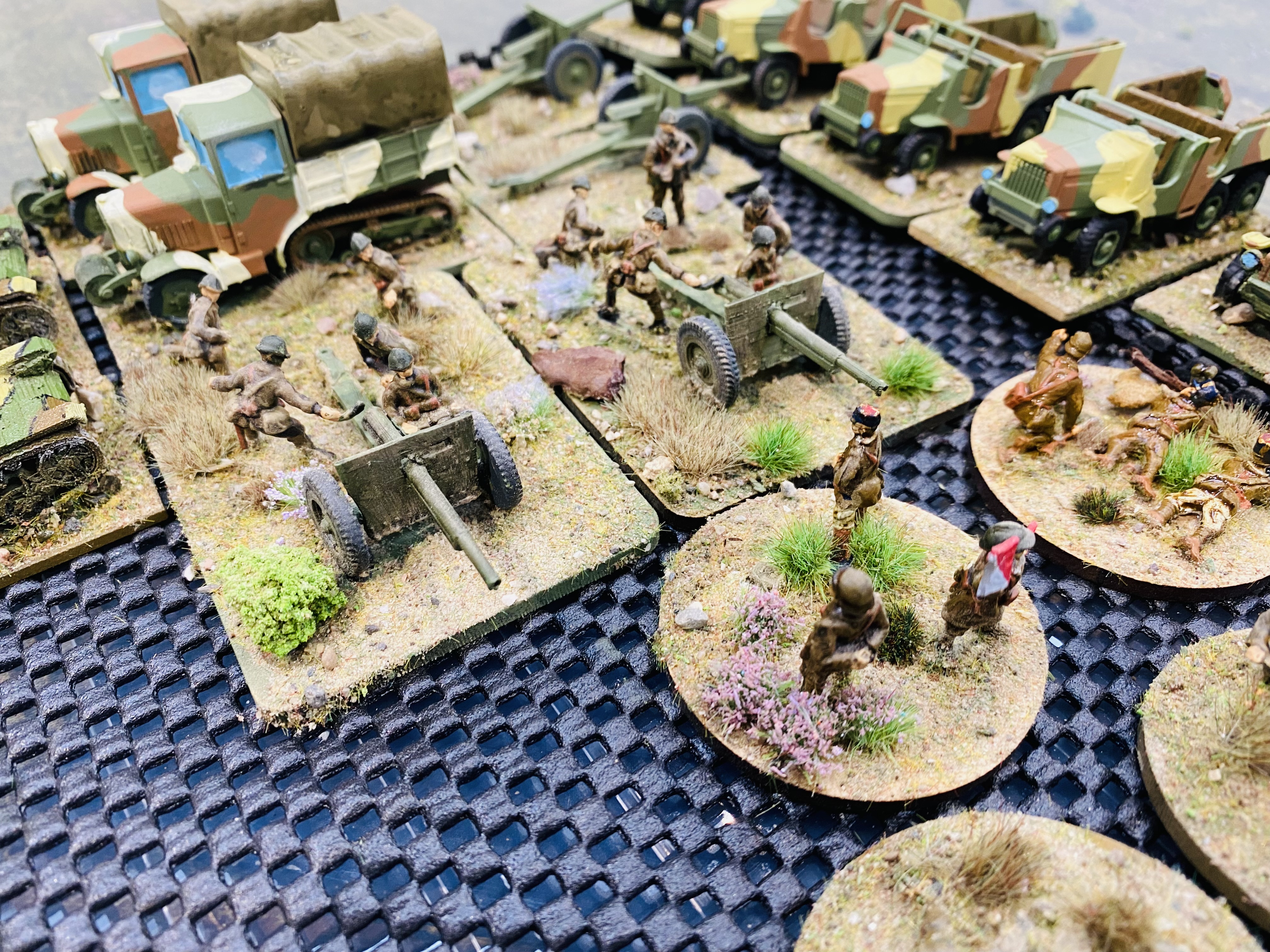
So, the other stuff referred to in this post’s title is a parade of almost all of my Allied forces for the Fall of France.

A battery of French 75’s

Royal Artillery,  and Morris armoured cars of 12th Lancers

AMR35 tanks and a Laffley truck with a 47mm AT gun on the back.

Royal Artillery again

Mortar carts for the Senegalese Tirailleurs.

4th Northumberland Fusiliers motorcycle battalion.


Two battalions of French Dragon Portee with attached armoured squadrons and motorcyclists..

Senegalese again.

Overhead view of elements of 50th Division. Not pictured are 6 and 8 DLI.
 

So that's it for now. I have a Franco-Prussian War game to write up from this week, which I shall get to shortly.


Thursday, 20 October 2022

The Battle For the Swiepwald, 3 July 1866

One of the latest from Helion’s ‘From Maxim to Musket’ series is ‘The Battle for the Swiepwald. Austria’s Fatal Blunder at Koniggratz, the Climactic Battle of the Austro-Prussian War, 3 July 1866.’ The author, Oberst Ernest Heinrich, was a serving officer in the KuK army, and first published this account in 1902, and it is refreshing to read such an in depth account of the battle from the Austrian perspective for a change. 


The battle for the Swiepwald was an unmitigated disaster for the Austrian army at Koniggratz. The great courage of her soldiers was outdone by the tactical incompetence and outright insubordination of two senior Austrian commanders, leaving thousands dead and wounded and the right flank of the army open to envelopment by the Prussian Second Army and the crushing defeat that followed.

The narrative is superbly done, taking us through every stage of the fighting at an incredible amount of minute detail, down to, for example, company and platoon level! The translation by Frederick Steinhardt is impressive and sympathetic to the original, maintaining the general frenetic pace of the battle. This is not just a word-for-word translation, and editor Gerard W Henry has also done a great job in pulling everything together, including reworking a number of sections, but only to ensure that the language is more appropriate for a modern-day reader.

The book is an absolute mine of information, and the translation provides the reader with a significant amount of indispensable facts thus allowing for a better understanding of events.

The book contains some really interesting maps detailing different stages of the fighting, and some excellent illustrations and photographs of the key areas of the battlefield, which are labelled to allow for referencing with the aforementioned maps, all of which are fascinating. Taken hand in hand with the forensic level of detail used when explaining how the fighting unfolded this is a truly magnificent book.

There are plenty of books on Koniggratz from the Prussian perspective; far fewer from that of the Austrians. Details of all the units and personal involved can be found throughout the text and the final chapter outlining the organised the Prussian and Austrian armies is contextually very helpful. This book goes a long way to resetting the balance between Prussian and Austrian accounts, and in short is simply tremendous# and is a must for anyone with an interest (or obsession in my case) in the Austro-Prussian War.


Monday, 17 October 2022

I didn’t go to the Other Partizan so I did this instead…….plus an update on the Boss.

……and I still spent more money of course on books I don’t really need. But there is space on the book shelves that needs (?) filling. 


I was signposted to these books by Alan Tiddmarsh at a recent Virtual Wargames Club Zoom meeting.
I have no interest or desire to do anything involving Samurai but they’re interesting and colourful.
My 18thC French army is based on the forces engaged in the War of the Polish Succession, so getting these was a bit of a no brainer. They follow the same format as all this publisher’s other books, lots of colourful pictures and loads of uniform details for each and every regiment.

I’ve also nearly completed a battalion of French Dragon Portees for the 1940 collection. I still need to finish their transport, the motor cycle company, armoured platoon and machine gun company so they’re not really finished at all now I come to think about it!
These figures are nearly all the excellent CP Models castings, with a few Early War Miniatures added.

I expect to get the remaining elements of this unit done in a couple of days, then I shall move on to some French armour and the second battalion of the Dragons Portee. In the pipeline and ready to start are the anti tank and artillery plus another battalion of French infantry. I might even do some horses cavalry….

On the domestic front Mrs A is still in hospital but much improved and she is now running the place like her own fiefdom. Surgery was a complete success, the stoma is working and the histology shows that the cancer has not spread anywhere else. (Praise be!) However, complications due to her usually tightly-controlled diabetes resulted in her almost dying as they failed to recognise what the problem was as she went into DKA after a week with no food, drink or meds! They didn’t even get the diabetic specialists involved, despite our repeated requests, until the point they felt she was fading fast. The hospital know they’ve cocked things up big time, and we shall see how things develop when our complaint goes in. Thanks to everyone for their continued good wishes.

Back to the painting desk now for a quick session on more French while I also need to start prepping the Germans.


Tuesday, 11 October 2022

Tirailleurs Senegalese for the fall of France project.

 I’ve almost finished this battalion Senegalese Tirailleurs, ie I need to give the bases some tufts when I next do a ‘tuftathon’ later this week here at the Burrow.    

The figures are all Early War Miniatures. 
There are three rifle companies, a machine gun company plus HQ. I suppose I should give them  a cart for their mortar and eventually they will have an attached anti-tank gun. I know they should all be wearing tin helmets but I wanted to differentiate between this unit and the next one off the blocks which is a bog standard metropolitan French battalion.

The rest of my planned French force includes a unit of dragons portees, motorcycle company and some armour, of which I have far too many in the box of doom. Oh well…..at least I will have a choice.

Just when you thought it was safe to go back to Helion’s webstore!!!!!


I thought I’d shaken off the Samurai bug a long time ago, but it seems that like the town of Amity Island in Jaws it’s definitely not safe to go back into the water, or in this case, Helion’s web store. 

‘The Shogun’s Soldiers, The Daily Life of Samurai and Soldiers in Early Edo Period Japan, 1603-1721 Volume 1’ is a tremendous book and one the author Michael Fredholm von Essen should be justly proud of. This is not simply a regurgitation of previously published aspects of Japanese military history but a new examination of the organisation, arms, armour, dress and daily life of the samurai and the soldiers and commoners in Edo-period Japan. The book also explores the events and reasons that led the Tokugawa shogunate to retreat into itself and begin a policy of self-imposed isolation, and stagnation, from the rest of the world.

The book is divided into chapters on the Shogun’s army, the people of Edo, the city and housing and public services, and these last two chapters are my clear favourites as they contain much around fascinating social history which I had hitherto been unaware of and makes an enlightening read, especially if you have an interest in seventeenth century Japanese policing, plumbing, latrines and garbage disposal to mention just a couple of subjects.

The military side of things are not ignored, and there is an in-depth examination of the army, it’s structure, organisation, training, weapons, equipment and armour. Of course being from Helion, the book is beautifully illustrated throughout, with a vast array of colour images of original arms and armour, contemporary colour and black and white drawings and eight specially commissioned colour plates by Giorgio Albertini depicting various samurai and ashigaru in different forms of dress and equipment. These are gorgeous.

In short, this is an excellent and inspiring book on a most complex subject, and the author has done a skilful job in bringing it to life in a scholarly but very readable way. I look forward to seeing volume 2 when it is released.

…..and I am NOT going to start a new Samurai project!


ISBN 978-1-915070-33-3 348 pages, paperback.


Wednesday, 5 October 2022

Another Fine Book


A Very Gallant Gentleman’ is yet another excellent volume from Helion’s Century of the Soldier series (No. 86 no less). The book is one of a growing patchwork of similar publications that are rapidly adding to the list of detailed histories based on a narrow focus, be it of an individual or a region. This narrow focus is a good thing for a couple of reasons. One, it allows for a much more forensic/in depth/scholarly examination of the subject matter, and two, at the present rate of publication there will come a time soon when there will be a study covering every region within the British Isles during the Civil Wars and every person of note or regiment of renown. 

This volume takes us through the life of Colonel Francis Thornhagh and the Nottinghamshire Horse until his untimely death at the Battle of Preston in 1648. Starting with some background about the family and their local parish, the book first looks at Francis’ early years leading up to the outbreak of hostilities, then two further chapters cover the years up to Parliament’s victory in 1646. Thornhagh’s contribution to the war effort is taken alongside the likes of Cromwell, Hutchinson and Poynz in the fighting against Prince Rupert and other Royalist commanders. Between 1646 and 1648 Thornhagh served as an independent MP and was a strong supporter of the army during this time.

As both an MP and commander of his regiment Thornhagh would be drawn into the events of the Second Civil War, campaigning in Wales and then in the north west, culminating in the Battle of Preston where he met his death fighting the Scots

Throughout the book we are treated to a great amount of detail. The writing is clear and engaging; I certainly feel after reading the book that I’ve learnt something about the Civil Wars and perhaps more importantly, the man, and was left wondering what he might have done with his life had he not been killed aged just 31.

The book is very well provided for with contemporary illustrations and black and white photographs of some of the key locations as they are today. There are also a number of very useful maps and some full page pen and ink illustrations by Maksim Borisov, who also produced the colour painting on the back of the book.

Another fascinating book and one I can recommend for those with any kind of interest in the British Civil Wars.

ISBN 978-1-915070-34-0 132 pages


Saturday, 1 October 2022

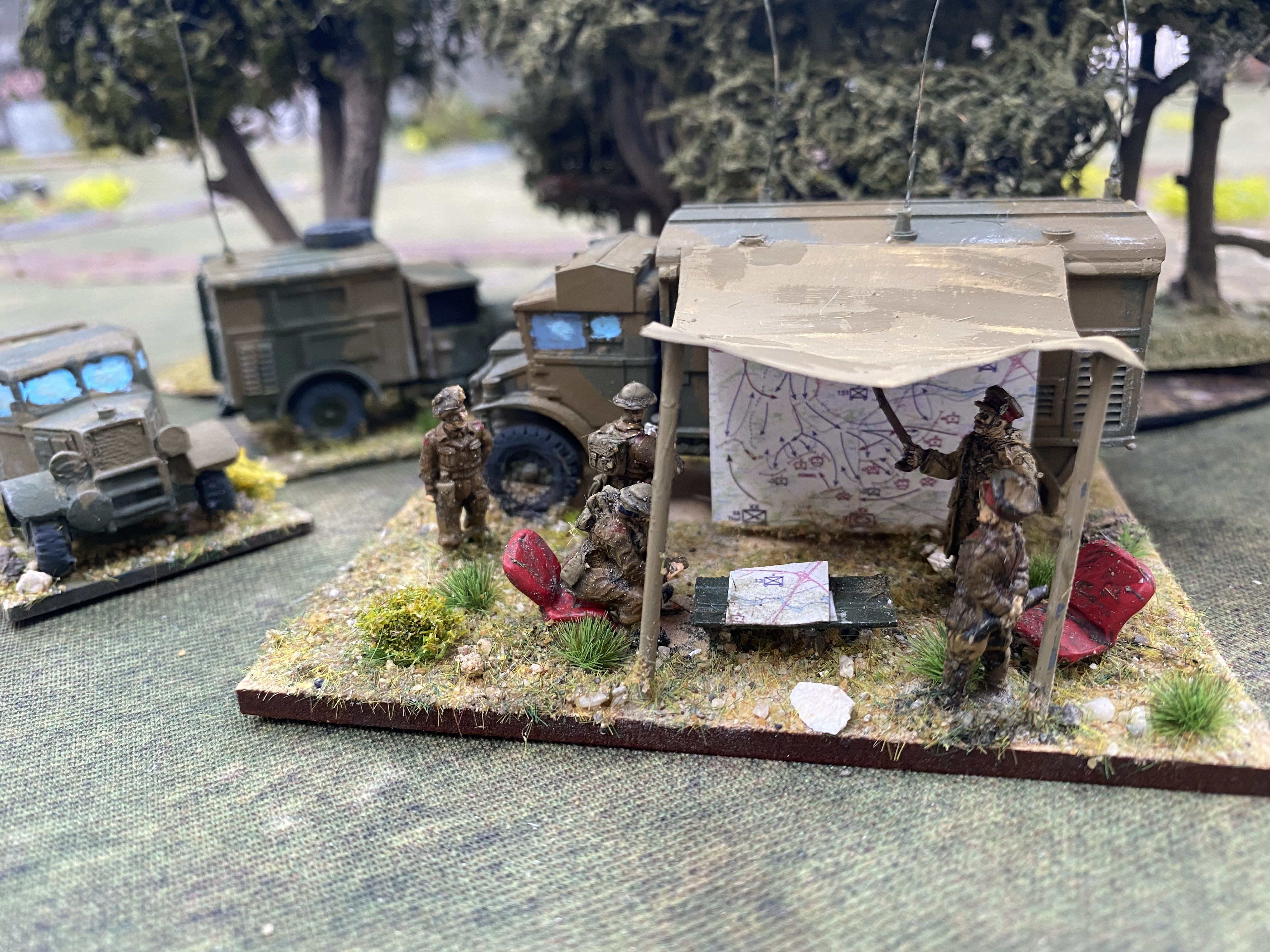
Headquarters for BEF - 1/72 scale


I finished this today, a command base for the HQ of the 50th Northumbrian Division for my Fall of France project. The command vehicle is a 3D print, as are the two smaller vehicles. The miniatures are a mixture of Early War, Eureka, CP models and an odd plastic bloke with his back to the camera. I added the tent and the large map hanging at the back is a much reduced copy of the actual British counter attack on the Germans at Arras. It’ll do.